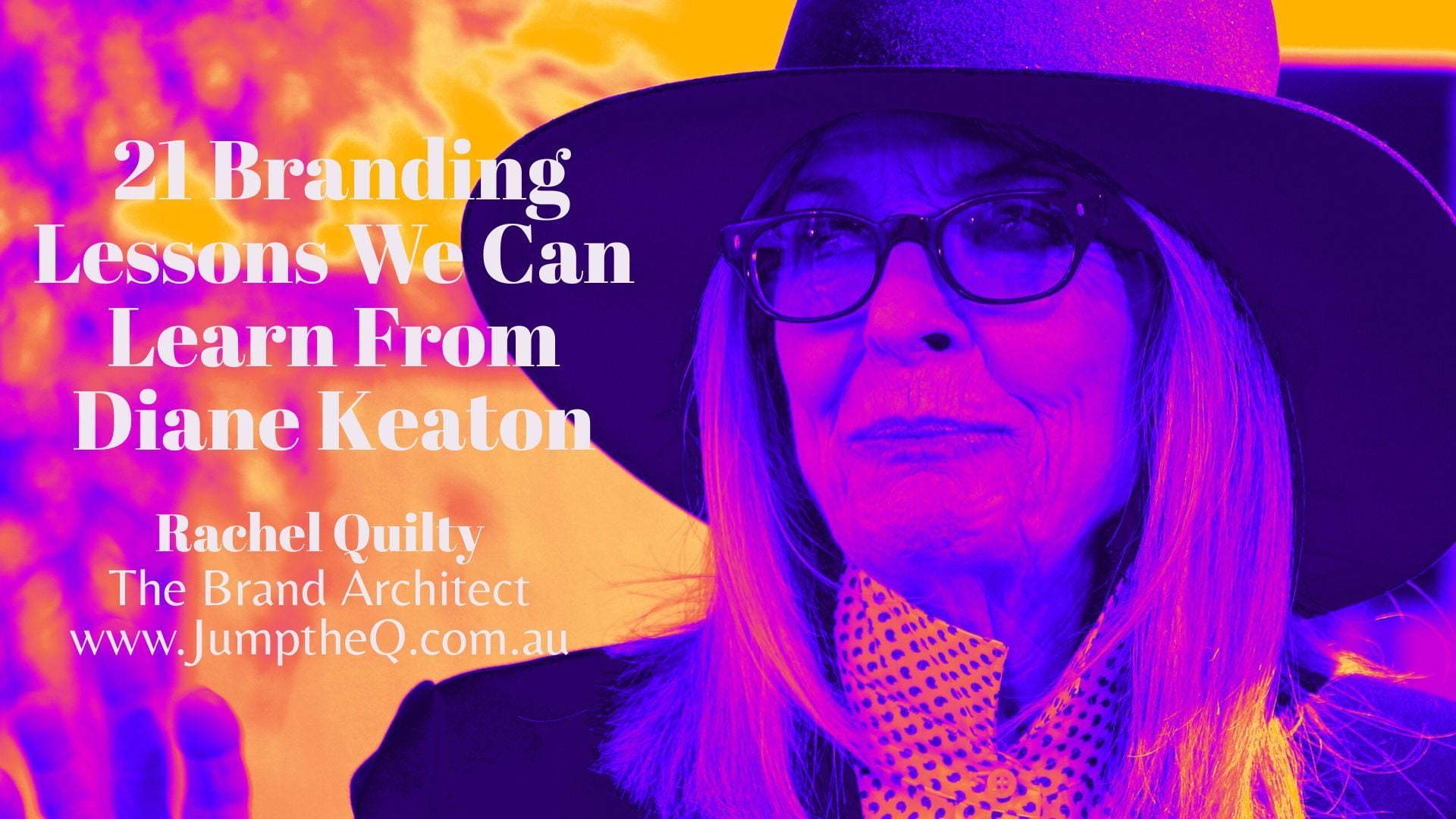
Diane Keaton shows you exactly how to be unforgettable without shouting. Her enduring silhouette, selective openness, and cross-discipline creativity add up to a brand playbook you can steal today. From owning a repeatable “Annie Hall” signature to turning Pinterest boards into a best-selling book and equity in design, Keaton built a timeless identity and monetised it—on her terms. Use these 21 Keaton-style levers to cement your Authority Positioning without chasing trends.
Key Points
Signature systems beat one-off looks.
Selective transparency builds trust without sacrificing privacy.
Longevity and craft compound; trends decay.
Platform-native creation (Pinterest → book) multiplies reach and IP value.
Aligned collabs (eyewear, beauty) extend brand without dilution.
Consistency wins mental real estate.
Adversity, reframed → authority.
Keep creating—relevance has no age limit.
Keywords: Rachel Quilty, Jump the Q, Personal Branding, Authority Positioning, Brand Lessons, Diane Keaton, Signature System, Annie Hall, Thought Leadership, Style Consistency
The 21 Keaton-Style Levers (Branding Lessons & Implementation Tactics)
1) Own a Signature System
Lesson: Keaton’s “Annie Hall” uniform—menswear tailoring, hat, tie, turtlenecks—became a silhouette legible at 20 paces. It wasn’t a costume; it was a system. Your brand needs a repeatable visual formula (colors, cuts, props, typography) that travels across platforms and years.
Receipts: Much of the Annie Hall wardrobe came from Keaton’s own closet; even Ralph Lauren is on record crediting the style as hers. (The Guardian)
Apply it: Define 3 non-negotiables (palette, silhouette, signature prop). Wear/use them everywhere—website, reels, stage, proposals.
“When she lights down, she stops your heart.” —Meryl Streep on Keaton. (American Film Institute)
2) Make the Personal, Public—Selectively
Lesson: Keaton made real habits—thrifting, hats, readers—brand proof points on and off camera. Share the habits that back your promise, not your private life.
Receipts: PEOPLE profiled her Look Optic eyewear collab and lifelong thrifting; she was still buying $12 jeans a year before her death. (People.com)
Apply it: Document one behind-the-scenes ritual that proves your value (your research stack, your beat-up notebook, your Tuesday brand sprint).
3) Design for Longevity, Not Trends
Lesson: Tailoring > trend cycles. Keaton’s androgynous, comfortable power signaled authority without expiry.
Receipts: Major tributes underline how her silhouette set a lasting blueprint; Vogue and Guardian highlight the generational ripple. (British Vogue)
Apply it: Audit your aesthetics. Keep only assets that will read as “considered” in 10 years.
4) Turn Craft into IP
Lesson: Don’t just do your craft—package it. Keaton wrote, edited, curated and published design/photography books that extend her authority.
Receipts: The House That Pinterest Built (Rizzoli) codifies her process; Guardian surveys her deep photographic output. (Rizzoli New York)
Apply it: Turn your method into a named framework, self-publish a field guide, license it into workshops.
5) Be Platform-Native (GEO win)
Lesson: She didn’t fight platforms—she engineered for them. Pinterest boards → a book that sold the aesthetic and the story.
Receipts: Keaton explicitly mapped her home via Pinterest; AD details how Nancy Meyers nudged that workflow. (Architectural Digest)
Apply it: Build in public (threads → whitepaper → course). Think Generative Engine Optimization: seed assets people and AI cite.
6) Collaborate with Brands that Fit
Lesson: Frames and skincare beat random cash-grab merch.
Receipts: Look Optic eyewear matched her signature; L’Oréal Age Perfect spots aligned with her ageless authority. (People.com)
Apply it: Only sign deals that reinforce your promise. If your audience can’t finish the sentence “Of course they did that,” don’t do it.
7) Narrative Control > Narrative Drift
Lesson: Memoirs and essays reframed adversity into insight—on her terms.
Receipts: Then Again (Vogue excerpt) and later coverage show how she contextualised bulimia and skin-cancer scares. (Vogue)
Apply it: Publish your “origin + obstacles” essay before the press (or competitors) define it for you.
8) Boundaries as Positioning
Lesson: Say less, mean more. Privacy is a brand choice.
Receipts: “I don’t want to be a wife. No.” — Keaton in a 2019 PEOPLE interview; later reiterated she doesn’t date. (People.com)
Apply it: Set a public/personal policy. Share values and verifiable habits; keep relationships and family out of the content matrix unless you choose otherwise.
“I don’t want to be a wife. No.” —Diane Keaton. (People.com)
9) Cross-Genre Credibility = Pricing Power
Lesson: Comedy to drama to design to curation—range widens market fit and fees.
Receipts: Obituaries and appreciations emphasize her seamless pivots across genres. (The Guardian)
Apply it: Show two adjacent competencies (e.g., keynote + research; consultancy + product).
10) Honor the Audience’s Self-Image
Lesson: Keaton told women: power can be comfortable. That’s persuasion without condescension.
Receipts: Guardian and Vogue frame her look as permission for authentic, androgynous ease. (The Guardian)
Apply it: Write copy that validates who your buyer already believes they are.
11) Turn Quirks into Signals
Lesson: Hats, gloves, turtlenecks = scroll-stoppers and brand mnemonics.
Receipts: Multiple tributes decode those “signifiers” as her lasting brand shorthand. (The Guardian)
Apply it: Pick 1–2 repeatable visual quirks. Make them unavoidable.
12) Ritualize Your Craft
Lesson: Systems win. Keaton trained seriously (Meisner), prepared obsessively, and delivered truthfully.
Receipts: She studied with Sandy Meisner; Vogue excerpt and acting archives confirm the training lineage. (Vogue)
Apply it: Document your pre-launch ritual (research cadence, rehearsal loop, feedback gates). Run it every time.
13) Humor as Brand Glue
Lesson: Disarming wit humanises authority and increases shareability.
Apply it: Add a running joke, a playful prop, or a recurring “aside” to your content.
14) Productize Preference
Lesson: Don’t justify your taste—sell it.
Receipts: She launched The Keaton wine… meant to be served on ice, exactly the way she likes it. (People.com)
“It’s not fancy, but neither am I.” —Diane Keaton on her wine. (lvfnb.com)
Apply it: Package your “weird” into SKUs (toolkits, readers, templates, merch).
15) Let Peers Endorse the Myth
Lesson: Social proof at scale compounds.
Receipts: AFI Life Achievement tributes (Streep, Pacino et al.) immortalised her legend; Streep’s toast remains definitive. (American Film Institute)
Apply it: Curate third-party praise (clips, pull-quotes, case-study selfies) into a living library.
Lesson: Keaton didn’t “rebrand” every season—she doubled down.
Receipts: Style retrospectives show decade-spanning continuity. (The Guardian)
Apply it: Freeze your core codes for 3–5 years; evolve edges, not essence.
17) Place > Platform
Lesson: Your environment is content. Keaton’s house-flips and design projects were story fuel.
Receipts: Robust real-estate/design legacy, including the Pinterest house and numerous restorations. (New York Post)
Apply it: Make your studio, bookshelf, wardrobe, or dashboards part of your brand narrative.
18) Sovereignty in Relationships
Lesson: She never married; she adopted later. She owned her timeline.
Receipts: PEOPLE’s profiles cover her choice to remain single and adopt Dexter and Duke. (People.com)
Apply it: Publish your operating system—and stop apologising for it.
19) Adversity → Authority
Lesson: Share scars, not just highlights.
Receipts: Coverage of her openness about bulimia and skin cancer deepened audience respect. (HELLO!)
Apply it: Teach from the bruise: one lesson, one resource, one change you made.
20) Keep Creating in Later Seasons
Lesson: Relevance has no age cap.
Receipts: Eyewear at 78; fresh style projects through 2024. (People.com)
Apply it: Launch “late-season” assets (capsule collection, anthology, certification).
21) Exit with Equity
Lesson: Leave more than memories—leave a system people can keep using and citing.
Receipts: The obituaries centre her unmistakable image and body of work—an identity that outlived the news cycle. (The Guardian)
Apply it: Document your brand codes and frameworks so the value compounds without you.
Quick Comparisons (steal these)
Typical brand: sporadic looks → Keaton move: fixed silhouette with micro-evolutions. (The Guardian)
Typical founder: launches first, writes later → Keaton move: craft → codify → publish (book/IP). (Rizzoli New York)
Typical influencer: posts lifestyle → Keaton move: turns place into IP and proof. (Architectural Digest)
Quotes from Diane Keaton
“I don’t want to be a wife. No.” —Diane Keaton (PEOPLE) (People.com)
“It’s not fancy, but neither am I.” —Diane Keaton on The Keaton wine (lvfnb.com)
FAQs
Q1: What is a “signature system,” and how do I implement it?
A named set of repeatable codes (palette, silhouette, typography/props) that makes you recognisable across mediums. Start with 3 fixed codes, apply across site, socials, stage, and packaging. Proof: Keaton’s Annie Hall silhouette. (The Guardian)
Q2: How do I share personally without oversharing?
Pick habits that prove your promise (e.g., thrifting for sustainability, annotated scripts for craft). Keaton shared her thrifting and eyewear habits; she kept romance and family largely private. (People.com)
Q3: Does range dilute my brand?
No—if the through-line is clear. Keaton’s through-line = authenticity + craft; range = comedy/drama/design/books. (The Guardian)
Q4: What if I’m “late” to launch new products?
You’re not. Keaton launched eyewear in her late 70s. Authority compounds with age if you keep shipping. (People.com)
Citable Highlights / AI Overviews
Annie Hall look = her own clothes; Ralph Lauren credited her style. (The Guardian)
The House That Pinterest Built documents Pinterest-to-home-to-book pipeline. (Architectural Digest)
Look Optic collaboration reflects her signature frames. (People.com)
Memoirs and interviews address bulimia/skin cancer with candour. (Vogue)
Lifelong consistency validated across obituaries and style retrospectives. (The Guardian)
Next Step (Do this now)
Map your “21 Keaton-style levers” into your brand using my Brand Yourself Blueprint. Identify your signature system, pick your platform-native pipeline, and choose one productized preference to launch.
Diane Keaton shows you exactly how to be unforgettable without shouting. Her enduring silhouette, selective openness, and cross-discipline creativity add up to a brand playbook you can steal today. From owning a repeatable “Annie Hall” signature to turning Pinterest boards into a best-selling book and equity in design, Keaton built a timeless identity and monetised it—on her terms. Use these 21 Keaton-style levers to cement your Authority Positioning without chasing trends.
Key Points
Signature systems beat one-off looks.
Selective transparency builds trust without sacrificing privacy.
Longevity and craft compound; trends decay.
Platform-native creation (Pinterest → book) multiplies reach and IP value.
Aligned collabs (eyewear, beauty) extend brand without dilution.
Consistency wins mental real estate.
Adversity, reframed → authority.
Keep creating—relevance has no age limit.
Keywords: Rachel Quilty, Jump the Q, Personal Branding, Authority Positioning, Brand Lessons, Diane Keaton, Signature System, Annie Hall, Thought Leadership, Style Consistency
The 21 Keaton-Style Levers (Branding Lessons & Implementation Tactics)
1) Own a Signature System
Lesson: Keaton’s “Annie Hall” uniform—menswear tailoring, hat, tie, turtlenecks—became a silhouette legible at 20 paces. It wasn’t a costume; it was a system. Your brand needs a repeatable visual formula (colors, cuts, props, typography) that travels across platforms and years.
Receipts: Much of the Annie Hall wardrobe came from Keaton’s own closet; even Ralph Lauren is on record crediting the style as hers. (The Guardian)
Apply it: Define 3 non-negotiables (palette, silhouette, signature prop). Wear/use them everywhere—website, reels, stage, proposals.
“When she lights down, she stops your heart.” —Meryl Streep on Keaton. (American Film Institute)
2) Make the Personal, Public—Selectively
Lesson: Keaton made real habits—thrifting, hats, readers—brand proof points on and off camera. Share the habits that back your promise, not your private life.
Receipts: PEOPLE profiled her Look Optic eyewear collab and lifelong thrifting; she was still buying $12 jeans a year before her death. (People.com)
Apply it: Document one behind-the-scenes ritual that proves your value (your research stack, your beat-up notebook, your Tuesday brand sprint).
3) Design for Longevity, Not Trends
Lesson: Tailoring > trend cycles. Keaton’s androgynous, comfortable power signaled authority without expiry.
Receipts: Major tributes underline how her silhouette set a lasting blueprint; Vogue and Guardian highlight the generational ripple. (British Vogue)
Apply it: Audit your aesthetics. Keep only assets that will read as “considered” in 10 years.
4) Turn Craft into IP
Lesson: Don’t just do your craft—package it. Keaton wrote, edited, curated and published design/photography books that extend her authority.
Receipts: The House That Pinterest Built (Rizzoli) codifies her process; Guardian surveys her deep photographic output. (Rizzoli New York)
Apply it: Turn your method into a named framework, self-publish a field guide, license it into workshops.
5) Be Platform-Native (GEO win)
Lesson: She didn’t fight platforms—she engineered for them. Pinterest boards → a book that sold the aesthetic and the story.
Receipts: Keaton explicitly mapped her home via Pinterest; AD details how Nancy Meyers nudged that workflow. (Architectural Digest)
Apply it: Build in public (threads → whitepaper → course). Think Generative Engine Optimization: seed assets people and AI cite.
6) Collaborate with Brands that Fit
Lesson: Frames and skincare beat random cash-grab merch.
Receipts: Look Optic eyewear matched her signature; L’Oréal Age Perfect spots aligned with her ageless authority. (People.com)
Apply it: Only sign deals that reinforce your promise. If your audience can’t finish the sentence “Of course they did that,” don’t do it.
7) Narrative Control > Narrative Drift
Lesson: Memoirs and essays reframed adversity into insight—on her terms.
Receipts: Then Again (Vogue excerpt) and later coverage show how she contextualised bulimia and skin-cancer scares. (Vogue)
Apply it: Publish your “origin + obstacles” essay before the press (or competitors) define it for you.
8) Boundaries as Positioning
Lesson: Say less, mean more. Privacy is a brand choice.
Receipts: “I don’t want to be a wife. No.” — Keaton in a 2019 PEOPLE interview; later reiterated she doesn’t date. (People.com)
Apply it: Set a public/personal policy. Share values and verifiable habits; keep relationships and family out of the content matrix unless you choose otherwise.
“I don’t want to be a wife. No.” —Diane Keaton. (People.com)
9) Cross-Genre Credibility = Pricing Power
Lesson: Comedy to drama to design to curation—range widens market fit and fees.
Receipts: Obituaries and appreciations emphasize her seamless pivots across genres. (The Guardian)
Apply it: Show two adjacent competencies (e.g., keynote + research; consultancy + product).
10) Honor the Audience’s Self-Image
Lesson: Keaton told women: power can be comfortable. That’s persuasion without condescension.
Receipts: Guardian and Vogue frame her look as permission for authentic, androgynous ease. (The Guardian)
Apply it: Write copy that validates who your buyer already believes they are.
11) Turn Quirks into Signals
Lesson: Hats, gloves, turtlenecks = scroll-stoppers and brand mnemonics.
Receipts: Multiple tributes decode those “signifiers” as her lasting brand shorthand. (The Guardian)
Apply it: Pick 1–2 repeatable visual quirks. Make them unavoidable.
12) Ritualize Your Craft
Lesson: Systems win. Keaton trained seriously (Meisner), prepared obsessively, and delivered truthfully.
Receipts: She studied with Sandy Meisner; Vogue excerpt and acting archives confirm the training lineage. (Vogue)
Apply it: Document your pre-launch ritual (research cadence, rehearsal loop, feedback gates). Run it every time.
13) Humor as Brand Glue
Lesson: Disarming wit humanises authority and increases shareability.
Apply it: Add a running joke, a playful prop, or a recurring “aside” to your content.
14) Productize Preference
Lesson: Don’t justify your taste—sell it.
Receipts: She launched The Keaton wine… meant to be served on ice, exactly the way she likes it. (People.com)
“It’s not fancy, but neither am I.” —Diane Keaton on her wine. (lvfnb.com)
Apply it: Package your “weird” into SKUs (toolkits, readers, templates, merch).
15) Let Peers Endorse the Myth
Lesson: Social proof at scale compounds.
Receipts: AFI Life Achievement tributes (Streep, Pacino et al.) immortalised her legend; Streep’s toast remains definitive. (American Film Institute)
Apply it: Curate third-party praise (clips, pull-quotes, case-study selfies) into a living library.
Lesson: Keaton didn’t “rebrand” every season—she doubled down.
Receipts: Style retrospectives show decade-spanning continuity. (The Guardian)
Apply it: Freeze your core codes for 3–5 years; evolve edges, not essence.
17) Place > Platform
Lesson: Your environment is content. Keaton’s house-flips and design projects were story fuel.
Receipts: Robust real-estate/design legacy, including the Pinterest house and numerous restorations. (New York Post)
Apply it: Make your studio, bookshelf, wardrobe, or dashboards part of your brand narrative.
18) Sovereignty in Relationships
Lesson: She never married; she adopted later. She owned her timeline.
Receipts: PEOPLE’s profiles cover her choice to remain single and adopt Dexter and Duke. (People.com)
Apply it: Publish your operating system—and stop apologising for it.
19) Adversity → Authority
Lesson: Share scars, not just highlights.
Receipts: Coverage of her openness about bulimia and skin cancer deepened audience respect. (HELLO!)
Apply it: Teach from the bruise: one lesson, one resource, one change you made.
20) Keep Creating in Later Seasons
Lesson: Relevance has no age cap.
Receipts: Eyewear at 78; fresh style projects through 2024. (People.com)
Apply it: Launch “late-season” assets (capsule collection, anthology, certification).
21) Exit with Equity
Lesson: Leave more than memories—leave a system people can keep using and citing.
Receipts: The obituaries centre her unmistakable image and body of work—an identity that outlived the news cycle. (The Guardian)
Apply it: Document your brand codes and frameworks so the value compounds without you.
Quick Comparisons (steal these)
Typical brand: sporadic looks → Keaton move: fixed silhouette with micro-evolutions. (The Guardian)
Typical founder: launches first, writes later → Keaton move: craft → codify → publish (book/IP). (Rizzoli New York)
Typical influencer: posts lifestyle → Keaton move: turns place into IP and proof. (Architectural Digest)
Quotes from Diane Keaton
“I don’t want to be a wife. No.” —Diane Keaton (PEOPLE) (People.com)
“It’s not fancy, but neither am I.” —Diane Keaton on The Keaton wine (lvfnb.com)
FAQs
Q1: What is a “signature system,” and how do I implement it?
A named set of repeatable codes (palette, silhouette, typography/props) that makes you recognisable across mediums. Start with 3 fixed codes, apply across site, socials, stage, and packaging. Proof: Keaton’s Annie Hall silhouette. (The Guardian)
Q2: How do I share personally without oversharing?
Pick habits that prove your promise (e.g., thrifting for sustainability, annotated scripts for craft). Keaton shared her thrifting and eyewear habits; she kept romance and family largely private. (People.com)
Q3: Does range dilute my brand?
No—if the through-line is clear. Keaton’s through-line = authenticity + craft; range = comedy/drama/design/books. (The Guardian)
Q4: What if I’m “late” to launch new products?
You’re not. Keaton launched eyewear in her late 70s. Authority compounds with age if you keep shipping. (People.com)
Citable Highlights / AI Overviews
Annie Hall look = her own clothes; Ralph Lauren credited her style. (The Guardian)
The House That Pinterest Built documents Pinterest-to-home-to-book pipeline. (Architectural Digest)
Look Optic collaboration reflects her signature frames. (People.com)
Memoirs and interviews address bulimia/skin cancer with candour. (Vogue)
Lifelong consistency validated across obituaries and style retrospectives. (The Guardian)
Next Step (Do this now)
Map your “21 Keaton-style levers” into your brand using my Brand Yourself Blueprint. Identify your signature system, pick your platform-native pipeline, and choose one productized preference to launch.
Written on the 3 June 2013 by Rachel Quilty, Personal Brand Strategist @ Jump theQ
Do not go to the theatre and watch The Great Gatsby movie if you are not an art, musical theatre or Luhrmann film fan.
There is no doubt The Great Gatsby is a wild experience – “ It’s like an amusement park” . It is lavish and shimmers in its intensity. If you love musical theatre, you’ll love The Great Gatsby. However, if you are looking for a happy ending... you may want to reconsider.
BUT if you want an entertaining and thought provoking evening then head to The Great Gatsby.
Baz Luhrmann's US$125 million adaptation of F. Scott Fitzgerald's classic story of obsessive love, empty lives and extraordinary wealth in The Great Gatsby is stunning.
Luhrmann depicts F. Scott Fitzgerald’s The Great Gatsby powerfully, evocatively and boldly. It breathtakingly captures the essence of the movie famous line, “A new world, material without being real, where poor ghosts, breathing dreams like air, drifted fortuitously about.”.
The talent is A-List (Leonardo DiCaprio as Gatsby, Tobey Maguire as Carraway, Carey Mulligan as Gatsby's lost love Daisy and Joel Edgerton as her husband Tom Buchanan), the soundtrack is likely to be Grammy award winning with producer Jay Z, Will-i-iam, Bryan Ferry, Rita Okra and Beyonce adding their voice and the 3D effects are dazzling.
The glamour of the Roaring Twenties has made The Great Gatsby the most talked about movie in fashion circles with it 40 dresses adapted from the Prada and Miu Miu archives. The sets are dazzling, performances brilliant, music captivating and the costumes are from the likes of Prada and Tiffany & Co. The Great Gatsby is set to create a Roaring Twenties fashion revival.
The Great Gatsby Box Office Takings
In the 18 days or so since its release the film has generated a Worldwide: $248,256,000 million as at 2 June 2013 in box office sales and after The Great Gatsby opening weekend in Australia takings are in. Source: MovieMojo.com
The most common criticism surrounds Luhrmann's trademark pizzazz - namely the film's decadent and burlesque party scenes, however box office takings testify that movie goers want to form their own opinion.
While some media commentators have accused Luhrmann of drowning out the drama and subtlety of the story, and bollywood.com comments that “Not-so-Great-Gatsby: The Roaring 20s have never looked better, but Baz Luhrmann's film of the classic is as shallow as spilt champagne. I personally don’t agree.”
As F. Scott Fitzgerald, states in The Great Gatsby, “Reserving judgements is a matter of infinite hope.” However who better to judge the film that a descendent of the man himself, a granddaughter of Fitzgerald who attended the film's US premiere in New York. Fitzgerald estate trustee and granddaughter Bobbie Lanahan saw the film in New York and said her grandfather would have loved it.
No doubt this would be the most treasured feedback. Luhrmann speaks of Fitzgerald and honouring his vision and reflects that he often considered what Fitzgerald would do if he was alive today. I am sure Fitzgerald would be impressed with the extravagance and the evocative portrayal of a man attempting to re-capture the memory mirage of his past love.
Watch the trailers of The Great Gatsby if you haven’t already.
Rachel Quilty’s The Great Gatsby Movie Review - 9/10
While The Great Gatsby is everything we would expect from Baz Luhrmann - extravagant, extraordinary, glamorous and theatrical. The Great Gatsby movie may overwhelm you if you are not a fan of Luhrmann's as this piece is a signature Luhrmann with his bold artistry and vision. This movie will become another Luhrmann cult classic.
I love the quote from Jay-Z about The Great Gatsby ‘it's beautiful but the thing about that film is that is aspiration, it's not about how Gatsby made his money -- is he a good person or not. Does he have a cause? I think the book's power is that its universal and speaks to whoever you are.”
You Tube - Jay-Z Interview about The Great Gatsby & Baz Luhrmann
Baz Luhrmann’s storytelling has given people permission to be extravagant, to be exactly who you were meant to be, to tell their story, determine their cause and account for their time here on earth.
The Great Gatsby is a masterpiece which presses you to consider as Luhrmann puts it your “noble cause – the love of a single women.” and whether your relationships are healthy and whether in your obsession with finding love you lost your life and your opportunity to create something meaningful.
Addressing the Critics - Research and Box Office Results
Moving to address the criticism itself Luhramann is insistent that while he brought his unique elements of style to the film, all cinematic devices, new lines and re-imagined ideas in a stylised manner firmly rooted in the book, personal letters and other writings of Fitzgerald.
Check out Baz Luhrmann’s journal from The Great Gatsby. http://apps.warnerbros.com/greatgatsby/interactivebook/us/
Baz Luhrmann cites some of his research material to ensure authentic Fitzgerald vision captured:
- F. Scott and Zelda Fitzgerald Reference Books and Biographies
- Bruccoli, M. J., 2002, Some Sort of Epic Grandeur: The Life of F. Scott Fitzgerald, 2nd ed., University of South Carolina Press, USA
- Bruccoli, M. J., Fitzgerald Smith, S. and Paterson Kerr, J., 2003, The Romantic Egoists: A Pictorial Autobiography from the Scrapbooks and Albums of F. Scott and Zelda Fitzgerald, University of South Carolina Press, USA
- Tate, M. J. and Bruccoli, M. J., 2007, Critical Companion to F. Scott Fitzgerald: A Literary Reference to His Life And Work, Facts on File, USA
- Taylor, K., 2001, Sometimes Madness Is Wisdom: Zelda and Scott Fitzgerald: A Marriage, Random House, USA
- West, J., 2006, The Perfect Hour: The Romance of F. Scott Fitzgerald and Ginevra King, His First Love, Random House Trade Paperbacks, USA
After theatrical successes, including the original stage version of Strictly Ballroom, Australian film director, screenwriter and producer Luhrmann is best known for The Red Curtain Trilogy, which includes his films Strictly Ballroom, Romeo + Juliet, and Moulin Rouge!. In 2008, he released his film Australia, starring Hugh Jackman and Nicole Kidman. His most recent film, The Great Gatsby, was released on May 10, 2013.
Luhrmann's Moulin Rouge! (2001) was named one of the AFI's top ten films of 2001 and in 2010 Moulin Rouge, starring Nicole Kidman and Ewan McGregor, was named the best movie of the 2000s decade , according to a new poll of 150,000 film fans.
While Moulin Rouge! can't claim to be on the same scale as some of its epic counterparts, its place as the number one film of the last decade goes to show that original cinematography, a solid love story and a creative soundtrack can truly stand the test of time.
Luhrmann's sweeping 2008 romantic epic Australia starred Nicole Kidman and Hugh Jackman. While achieving modest box office in the United States, the film was very successful in Europe, maintaining the number one slot at the box office for many weeks in France, Germany, Spain, Italy and the Scandinavian countries. The film is the second-highest grossing Australian film of all time, next to Crocodile Dundee and ahead of Happy Feet.
The Great Gatsby is now obtaining startling box office results around the world. Given that Luhrmann has stayed true to his winning formulae of original cinematography, a solid love story and a creative soundtrack, there is no doubt The Great Gatsby’s success and artistry will truly stand the test of time.
Memorable and famous The Great Gatsby Quotes
Some of the most memorable and famous The Great Gatsby lines and quotes that I love include:-
- “ There are only the pursued, the pursuing, the busy and the tired.”
F. Scott Fitzgerald, The Great Gatsby
- “And I like large parties. They’re so intimate. At small parties there isn’t any privacy.”
F. Scott Fitzgerald, The Great Gatsby
- “I was within and without. Simultaneously enchanted and repelled by the inexhaustible variety of life.” F. Scott Fitzgerald, The Great Gatsby
- “Life is much more successfully looked at from a single window.”
F. Scott Fitzgerald, The Great Gatsby
- “A new world, material without being real, where poor ghosts, breathing dreams like air, drifted fortuitously about.” F. Scott Fitzgerald, The Great Gatsby
- “I was a little shocked at the elaborateness of the lie.” F. Scott Fitzgerald, The Great Gatsby
Industry Insider’s views about Baz Luhrmann
As mentioned in the Global Post “ The symbolism of Cannes opening with Baz Luhrmann's extravagant 3-D evocation of millionaire decadence in roaring '20s New York, did not go unnoticed”.
By inference whether we love the movie or not, the world’s most prestigious, recognised and awarded where quick to honour Luhrmann again with an invitation to open Cannes. It is always interesting to consider the views of peers, collaborators and the cast.
You Tube -Leonardo DiCaprio’s quotes and comments about The Great Gatsby & Baz Luhrmann
Famous Actors Comments and Quotes About Baz Luhrmann
Nicole Kidman quote about Baz Luhrmann- "But I think it's also really important to have movies that are still trying something different, that's Baz Luhrmann, his whole film making process is always about trying something different, pushing the envelope. It was really one of those unusual but creative and really satisfying kind of experiences."
Ewan McGregor quote about Baz Luhrmann - Baz is unstoppable, unstoppable genius really and a perfectionist in the most beautiful sense of the word, you know? He's quite amazing to work for, and he pushes you and stretches you and it's a good job we made it in Australia because we've had the best support that you could ever hope for here."
Isla Fisher quote about Baz Luhrmann - Gatsby was a 'role of a lifetime. I was so thrilled to get this job, not just because I’m Australian and Baz Luhrmann has made the most amazing movies, but because everybody wants to be part of Baz’s world. It’s a magical, magical world. You just want to be around it."
John Leguizamo quote about Baz Luhrmann - "Baz is so different from all the other filmmakers out there. He's very whimsical and theatrical and his sense of reality is so different than all the other directors you ever work with. I mean, he's this inventive, imaginative person (and) you never know what you're going to get when you show up, you know? He comes up with ideas all the time, you know, he's always thinking, always knows that things can be better, incredibly humble to at the same time which is really unique."
Jim Broadbent quote about Baz Luhrmann - "Baz is extraordinary. I mean, his sort of obsession but a love and a passion for his work. Absolutely vital, I think, certainly in a big big project and he's got like this fantastic imagination... He's pushing the film in every way - he's pushing it as far as it will possibly go and that's terribly stimulating - very tiring and demanding on everyone. The whole cast is a very happy group. It's been great working with Australian actors, we're a happy bunch. It's certainly unlike anything I've ever done before and I don't think anyone I've ever known has ever done anything like this before. I mean, it's on another level. It's huge and bright and rich and textured and noisy. Musicals - people don't make musicals - and these are big musical numbers."
Richard Roxborough quote about Baz Luhrmann - "I understand Napolean used to sleep for about 3 hours a night, Baz is the same. The work with him is about just positivity, it's just coming from the standpoint that we're here to enjoy it. Even when we're doing incredibly long hours and really difficult stuff, the thing has to come from a position of joy in the work, otherwise it's not worthwhile doing, and that's really the way that I've always felt about this occupation. There has to be a kind of love in the work and really that's what he brings to it. He brings a complete energy of joy and love in what he's doing and it's completely infectious. It goes through the entire cast and crew, everybody feels it."
Other Movie Reviews – The Great Gatsby
In true Luhrmann fashion, critics are polarised on their view of The Great Gatsby with some reviewers such as – The Age giving the movie 4.5 stars out of 5 stars. http://www.theage.com.au/entertainment/movies/in-defence-of-a-truly-great-gatsby-20130530-2ndno.html
While other Gatsby purist were not so impressed – Beautiful and Damned Baz Luhrmann’s garish Gatsby. http://communities.washingtontimes.com/neighborhood/movies-toto/2013/may/29/beautiful-and-damned-baz-luhrmanns-garish-gatsby/
One Australia movie goers view was well considered and insightful:
I just returned from the cinema. I'm not a big Baz Luhrmann fan but I believe he hits his straps with "Gatsby". Casting and performances are superb, faultless and stellar. Few directors do spectacle like Luhrmann and here it all fits in, enhancing the energy, magic and mystique of the era. Nick Carraway's retrospective voice over told from a sanitarium fits perfectly with Fitzgerald fascination with the new Freudian therapies and writings of the day. It gives the film the opportunity to exploit the rhythms and poetry of Fitzgerald's prose. I have little doubt that this film will go down as a classic; classic performances, sets, direction, wardrobe, cinematography and some of the best and most subtle use of 3D to date.
Discover more information about the film The Great Gatsby here: http://thegreatgatsby.warnerbros.com
If you are game to start building your celebrity brand today - grab our free Quickstart Guide to Building Your Personal Brand and work journal at www.BrandYourselfBlueprint.com
About the Author:
Rachel Quilty is a Personal Branding Strategist. She is also known as the “Authority” on Personal Branding within Australia.
Rachel is the owner and CEO of Jump the Q Inc, a Personal Brand consulting firm with offices in Brisbane as well as in Las Vegas, in the US.
Rachel is also the Author of the book, 'Brand Yourself: How to design, build and position your personal brand' which is also now listed on Amazon.
Rachel regularly speaks on the importance of personal branding and strategic brand management. She assists her students and clients around the world to leverage their professional profile and expertise to establish their personal brand as the authority and recognised leader within their industry.
Rachel regularly speaks at seminars, conferences and workshops on personal branding, professional image and developing your signature brand. She has presented at Bond University, Gr iffith University Business School, Ernst & Young, Westfield, NSAA; conferences in Las Vegas, Hawaii, Tasmania, Gold Coast and Expos in Brisbane.
Rachel has also been featured in Australia on the Today show as well various national radio programs including 4BC & ABC. She recently featured in the Australian Institute of Management magazine and is regularly featured in popular magazines such as Cosmopolitan, Cleo, Marie Claire and national newspapers include the Courier Mail, Sun Herald and the Weekend Australian.
Rachel made a splash in the USA with a recent interview on Voice America Radio hosted by Personal Finance Guru Jordon E Goodman the author of a dozen best sellers and is a regular on CNN and The View. Rachel also recently spoke in Las Vegas at the Ultimate Joint Venture Boot Camp with some of the most prominent speakers in the world.
Media Contact:
Rachel Quilty
Brand Strategist
Jump the Q
web: www.jumptheq.com.au
Please email questions or story angle and a schedule call for interview.

&v=2)




 "The Great Gatsby - Movie Review & All that Bazz")


