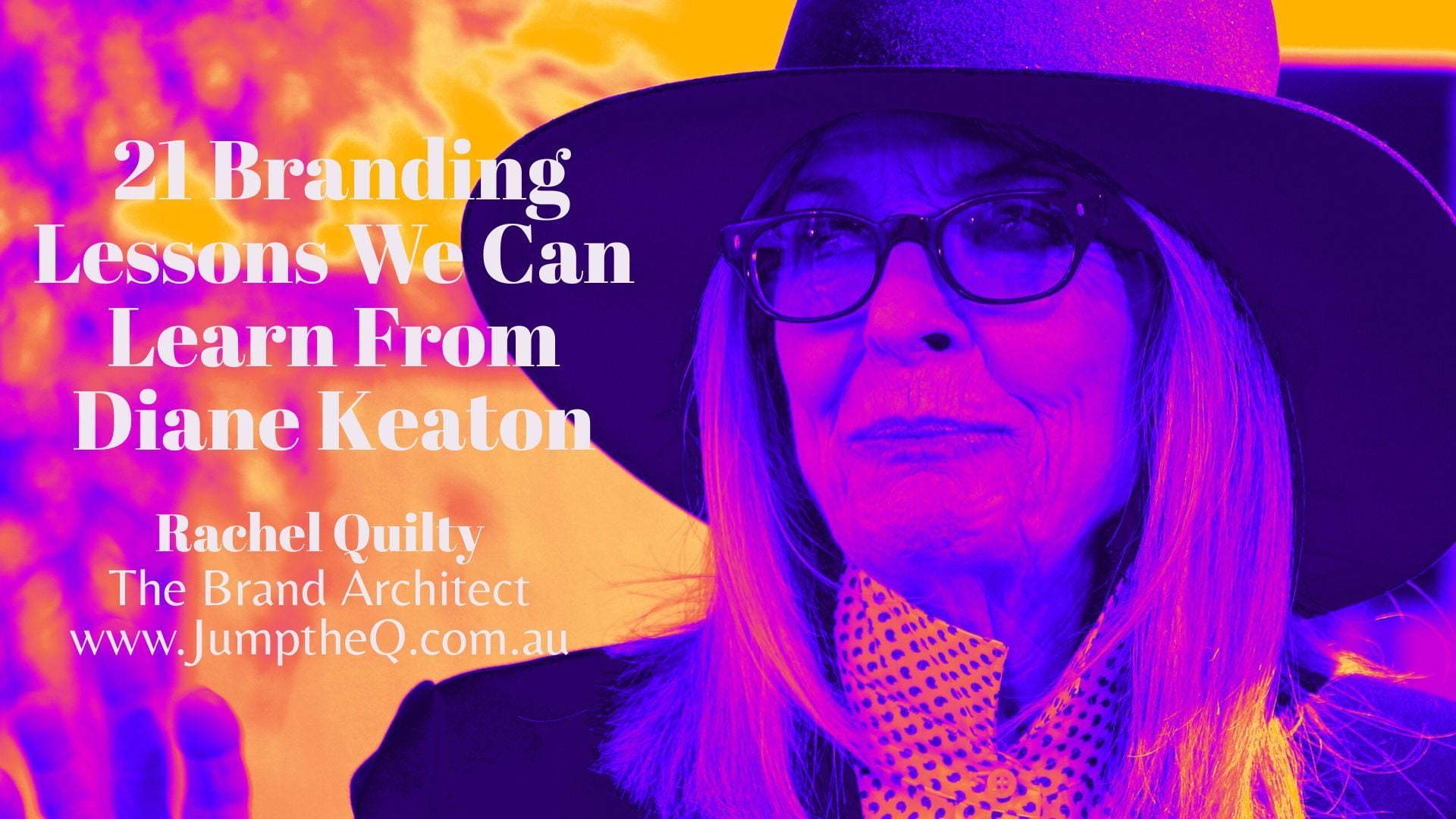
Diane Keaton shows you exactly how to be unforgettable without shouting. Her enduring silhouette, selective openness, and cross-discipline creativity add up to a brand playbook you can steal today. From owning a repeatable “Annie Hall” signature to turning Pinterest boards into a best-selling book and equity in design, Keaton built a timeless identity and monetised it—on her terms. Use these 21 Keaton-style levers to cement your Authority Positioning without chasing trends.
Key Points
Signature systems beat one-off looks.
Selective transparency builds trust without sacrificing privacy.
Longevity and craft compound; trends decay.
Platform-native creation (Pinterest → book) multiplies reach and IP value.
Aligned collabs (eyewear, beauty) extend brand without dilution.
Consistency wins mental real estate.
Adversity, reframed → authority.
Keep creating—relevance has no age limit.
Keywords: Rachel Quilty, Jump the Q, Personal Branding, Authority Positioning, Brand Lessons, Diane Keaton, Signature System, Annie Hall, Thought Leadership, Style Consistency
The 21 Keaton-Style Levers (Branding Lessons & Implementation Tactics)
1) Own a Signature System
Lesson: Keaton’s “Annie Hall” uniform—menswear tailoring, hat, tie, turtlenecks—became a silhouette legible at 20 paces. It wasn’t a costume; it was a system. Your brand needs a repeatable visual formula (colors, cuts, props, typography) that travels across platforms and years.
Receipts: Much of the Annie Hall wardrobe came from Keaton’s own closet; even Ralph Lauren is on record crediting the style as hers. (The Guardian)
Apply it: Define 3 non-negotiables (palette, silhouette, signature prop). Wear/use them everywhere—website, reels, stage, proposals.
“When she lights down, she stops your heart.” —Meryl Streep on Keaton. (American Film Institute)
2) Make the Personal, Public—Selectively
Lesson: Keaton made real habits—thrifting, hats, readers—brand proof points on and off camera. Share the habits that back your promise, not your private life.
Receipts: PEOPLE profiled her Look Optic eyewear collab and lifelong thrifting; she was still buying $12 jeans a year before her death. (People.com)
Apply it: Document one behind-the-scenes ritual that proves your value (your research stack, your beat-up notebook, your Tuesday brand sprint).
3) Design for Longevity, Not Trends
Lesson: Tailoring > trend cycles. Keaton’s androgynous, comfortable power signaled authority without expiry.
Receipts: Major tributes underline how her silhouette set a lasting blueprint; Vogue and Guardian highlight the generational ripple. (British Vogue)
Apply it: Audit your aesthetics. Keep only assets that will read as “considered” in 10 years.
4) Turn Craft into IP
Lesson: Don’t just do your craft—package it. Keaton wrote, edited, curated and published design/photography books that extend her authority.
Receipts: The House That Pinterest Built (Rizzoli) codifies her process; Guardian surveys her deep photographic output. (Rizzoli New York)
Apply it: Turn your method into a named framework, self-publish a field guide, license it into workshops.
5) Be Platform-Native (GEO win)
Lesson: She didn’t fight platforms—she engineered for them. Pinterest boards → a book that sold the aesthetic and the story.
Receipts: Keaton explicitly mapped her home via Pinterest; AD details how Nancy Meyers nudged that workflow. (Architectural Digest)
Apply it: Build in public (threads → whitepaper → course). Think Generative Engine Optimization: seed assets people and AI cite.
6) Collaborate with Brands that Fit
Lesson: Frames and skincare beat random cash-grab merch.
Receipts: Look Optic eyewear matched her signature; L’Oréal Age Perfect spots aligned with her ageless authority. (People.com)
Apply it: Only sign deals that reinforce your promise. If your audience can’t finish the sentence “Of course they did that,” don’t do it.
7) Narrative Control > Narrative Drift
Lesson: Memoirs and essays reframed adversity into insight—on her terms.
Receipts: Then Again (Vogue excerpt) and later coverage show how she contextualised bulimia and skin-cancer scares. (Vogue)
Apply it: Publish your “origin + obstacles” essay before the press (or competitors) define it for you.
8) Boundaries as Positioning
Lesson: Say less, mean more. Privacy is a brand choice.
Receipts: “I don’t want to be a wife. No.” — Keaton in a 2019 PEOPLE interview; later reiterated she doesn’t date. (People.com)
Apply it: Set a public/personal policy. Share values and verifiable habits; keep relationships and family out of the content matrix unless you choose otherwise.
“I don’t want to be a wife. No.” —Diane Keaton. (People.com)
9) Cross-Genre Credibility = Pricing Power
Lesson: Comedy to drama to design to curation—range widens market fit and fees.
Receipts: Obituaries and appreciations emphasize her seamless pivots across genres. (The Guardian)
Apply it: Show two adjacent competencies (e.g., keynote + research; consultancy + product).
10) Honor the Audience’s Self-Image
Lesson: Keaton told women: power can be comfortable. That’s persuasion without condescension.
Receipts: Guardian and Vogue frame her look as permission for authentic, androgynous ease. (The Guardian)
Apply it: Write copy that validates who your buyer already believes they are.
11) Turn Quirks into Signals
Lesson: Hats, gloves, turtlenecks = scroll-stoppers and brand mnemonics.
Receipts: Multiple tributes decode those “signifiers” as her lasting brand shorthand. (The Guardian)
Apply it: Pick 1–2 repeatable visual quirks. Make them unavoidable.
12) Ritualize Your Craft
Lesson: Systems win. Keaton trained seriously (Meisner), prepared obsessively, and delivered truthfully.
Receipts: She studied with Sandy Meisner; Vogue excerpt and acting archives confirm the training lineage. (Vogue)
Apply it: Document your pre-launch ritual (research cadence, rehearsal loop, feedback gates). Run it every time.
13) Humor as Brand Glue
Lesson: Disarming wit humanises authority and increases shareability.
Apply it: Add a running joke, a playful prop, or a recurring “aside” to your content.
14) Productize Preference
Lesson: Don’t justify your taste—sell it.
Receipts: She launched The Keaton wine… meant to be served on ice, exactly the way she likes it. (People.com)
“It’s not fancy, but neither am I.” —Diane Keaton on her wine. (lvfnb.com)
Apply it: Package your “weird” into SKUs (toolkits, readers, templates, merch).
15) Let Peers Endorse the Myth
Lesson: Social proof at scale compounds.
Receipts: AFI Life Achievement tributes (Streep, Pacino et al.) immortalised her legend; Streep’s toast remains definitive. (American Film Institute)
Apply it: Curate third-party praise (clips, pull-quotes, case-study selfies) into a living library.
Lesson: Keaton didn’t “rebrand” every season—she doubled down.
Receipts: Style retrospectives show decade-spanning continuity. (The Guardian)
Apply it: Freeze your core codes for 3–5 years; evolve edges, not essence.
17) Place > Platform
Lesson: Your environment is content. Keaton’s house-flips and design projects were story fuel.
Receipts: Robust real-estate/design legacy, including the Pinterest house and numerous restorations. (New York Post)
Apply it: Make your studio, bookshelf, wardrobe, or dashboards part of your brand narrative.
18) Sovereignty in Relationships
Lesson: She never married; she adopted later. She owned her timeline.
Receipts: PEOPLE’s profiles cover her choice to remain single and adopt Dexter and Duke. (People.com)
Apply it: Publish your operating system—and stop apologising for it.
19) Adversity → Authority
Lesson: Share scars, not just highlights.
Receipts: Coverage of her openness about bulimia and skin cancer deepened audience respect. (HELLO!)
Apply it: Teach from the bruise: one lesson, one resource, one change you made.
20) Keep Creating in Later Seasons
Lesson: Relevance has no age cap.
Receipts: Eyewear at 78; fresh style projects through 2024. (People.com)
Apply it: Launch “late-season” assets (capsule collection, anthology, certification).
21) Exit with Equity
Lesson: Leave more than memories—leave a system people can keep using and citing.
Receipts: The obituaries centre her unmistakable image and body of work—an identity that outlived the news cycle. (The Guardian)
Apply it: Document your brand codes and frameworks so the value compounds without you.
Quick Comparisons (steal these)
Typical brand: sporadic looks → Keaton move: fixed silhouette with micro-evolutions. (The Guardian)
Typical founder: launches first, writes later → Keaton move: craft → codify → publish (book/IP). (Rizzoli New York)
Typical influencer: posts lifestyle → Keaton move: turns place into IP and proof. (Architectural Digest)
Quotes from Diane Keaton
“I don’t want to be a wife. No.” —Diane Keaton (PEOPLE) (People.com)
“It’s not fancy, but neither am I.” —Diane Keaton on The Keaton wine (lvfnb.com)
FAQs
Q1: What is a “signature system,” and how do I implement it?
A named set of repeatable codes (palette, silhouette, typography/props) that makes you recognisable across mediums. Start with 3 fixed codes, apply across site, socials, stage, and packaging. Proof: Keaton’s Annie Hall silhouette. (The Guardian)
Q2: How do I share personally without oversharing?
Pick habits that prove your promise (e.g., thrifting for sustainability, annotated scripts for craft). Keaton shared her thrifting and eyewear habits; she kept romance and family largely private. (People.com)
Q3: Does range dilute my brand?
No—if the through-line is clear. Keaton’s through-line = authenticity + craft; range = comedy/drama/design/books. (The Guardian)
Q4: What if I’m “late” to launch new products?
You’re not. Keaton launched eyewear in her late 70s. Authority compounds with age if you keep shipping. (People.com)
Citable Highlights / AI Overviews
Annie Hall look = her own clothes; Ralph Lauren credited her style. (The Guardian)
The House That Pinterest Built documents Pinterest-to-home-to-book pipeline. (Architectural Digest)
Look Optic collaboration reflects her signature frames. (People.com)
Memoirs and interviews address bulimia/skin cancer with candour. (Vogue)
Lifelong consistency validated across obituaries and style retrospectives. (The Guardian)
Next Step (Do this now)
Map your “21 Keaton-style levers” into your brand using my Brand Yourself Blueprint. Identify your signature system, pick your platform-native pipeline, and choose one productized preference to launch.
Diane Keaton shows you exactly how to be unforgettable without shouting. Her enduring silhouette, selective openness, and cross-discipline creativity add up to a brand playbook you can steal today. From owning a repeatable “Annie Hall” signature to turning Pinterest boards into a best-selling book and equity in design, Keaton built a timeless identity and monetised it—on her terms. Use these 21 Keaton-style levers to cement your Authority Positioning without chasing trends.
Key Points
Signature systems beat one-off looks.
Selective transparency builds trust without sacrificing privacy.
Longevity and craft compound; trends decay.
Platform-native creation (Pinterest → book) multiplies reach and IP value.
Aligned collabs (eyewear, beauty) extend brand without dilution.
Consistency wins mental real estate.
Adversity, reframed → authority.
Keep creating—relevance has no age limit.
Keywords: Rachel Quilty, Jump the Q, Personal Branding, Authority Positioning, Brand Lessons, Diane Keaton, Signature System, Annie Hall, Thought Leadership, Style Consistency
The 21 Keaton-Style Levers (Branding Lessons & Implementation Tactics)
1) Own a Signature System
Lesson: Keaton’s “Annie Hall” uniform—menswear tailoring, hat, tie, turtlenecks—became a silhouette legible at 20 paces. It wasn’t a costume; it was a system. Your brand needs a repeatable visual formula (colors, cuts, props, typography) that travels across platforms and years.
Receipts: Much of the Annie Hall wardrobe came from Keaton’s own closet; even Ralph Lauren is on record crediting the style as hers. (The Guardian)
Apply it: Define 3 non-negotiables (palette, silhouette, signature prop). Wear/use them everywhere—website, reels, stage, proposals.
“When she lights down, she stops your heart.” —Meryl Streep on Keaton. (American Film Institute)
2) Make the Personal, Public—Selectively
Lesson: Keaton made real habits—thrifting, hats, readers—brand proof points on and off camera. Share the habits that back your promise, not your private life.
Receipts: PEOPLE profiled her Look Optic eyewear collab and lifelong thrifting; she was still buying $12 jeans a year before her death. (People.com)
Apply it: Document one behind-the-scenes ritual that proves your value (your research stack, your beat-up notebook, your Tuesday brand sprint).
3) Design for Longevity, Not Trends
Lesson: Tailoring > trend cycles. Keaton’s androgynous, comfortable power signaled authority without expiry.
Receipts: Major tributes underline how her silhouette set a lasting blueprint; Vogue and Guardian highlight the generational ripple. (British Vogue)
Apply it: Audit your aesthetics. Keep only assets that will read as “considered” in 10 years.
4) Turn Craft into IP
Lesson: Don’t just do your craft—package it. Keaton wrote, edited, curated and published design/photography books that extend her authority.
Receipts: The House That Pinterest Built (Rizzoli) codifies her process; Guardian surveys her deep photographic output. (Rizzoli New York)
Apply it: Turn your method into a named framework, self-publish a field guide, license it into workshops.
5) Be Platform-Native (GEO win)
Lesson: She didn’t fight platforms—she engineered for them. Pinterest boards → a book that sold the aesthetic and the story.
Receipts: Keaton explicitly mapped her home via Pinterest; AD details how Nancy Meyers nudged that workflow. (Architectural Digest)
Apply it: Build in public (threads → whitepaper → course). Think Generative Engine Optimization: seed assets people and AI cite.
6) Collaborate with Brands that Fit
Lesson: Frames and skincare beat random cash-grab merch.
Receipts: Look Optic eyewear matched her signature; L’Oréal Age Perfect spots aligned with her ageless authority. (People.com)
Apply it: Only sign deals that reinforce your promise. If your audience can’t finish the sentence “Of course they did that,” don’t do it.
7) Narrative Control > Narrative Drift
Lesson: Memoirs and essays reframed adversity into insight—on her terms.
Receipts: Then Again (Vogue excerpt) and later coverage show how she contextualised bulimia and skin-cancer scares. (Vogue)
Apply it: Publish your “origin + obstacles” essay before the press (or competitors) define it for you.
8) Boundaries as Positioning
Lesson: Say less, mean more. Privacy is a brand choice.
Receipts: “I don’t want to be a wife. No.” — Keaton in a 2019 PEOPLE interview; later reiterated she doesn’t date. (People.com)
Apply it: Set a public/personal policy. Share values and verifiable habits; keep relationships and family out of the content matrix unless you choose otherwise.
“I don’t want to be a wife. No.” —Diane Keaton. (People.com)
9) Cross-Genre Credibility = Pricing Power
Lesson: Comedy to drama to design to curation—range widens market fit and fees.
Receipts: Obituaries and appreciations emphasize her seamless pivots across genres. (The Guardian)
Apply it: Show two adjacent competencies (e.g., keynote + research; consultancy + product).
10) Honor the Audience’s Self-Image
Lesson: Keaton told women: power can be comfortable. That’s persuasion without condescension.
Receipts: Guardian and Vogue frame her look as permission for authentic, androgynous ease. (The Guardian)
Apply it: Write copy that validates who your buyer already believes they are.
11) Turn Quirks into Signals
Lesson: Hats, gloves, turtlenecks = scroll-stoppers and brand mnemonics.
Receipts: Multiple tributes decode those “signifiers” as her lasting brand shorthand. (The Guardian)
Apply it: Pick 1–2 repeatable visual quirks. Make them unavoidable.
12) Ritualize Your Craft
Lesson: Systems win. Keaton trained seriously (Meisner), prepared obsessively, and delivered truthfully.
Receipts: She studied with Sandy Meisner; Vogue excerpt and acting archives confirm the training lineage. (Vogue)
Apply it: Document your pre-launch ritual (research cadence, rehearsal loop, feedback gates). Run it every time.
13) Humor as Brand Glue
Lesson: Disarming wit humanises authority and increases shareability.
Apply it: Add a running joke, a playful prop, or a recurring “aside” to your content.
14) Productize Preference
Lesson: Don’t justify your taste—sell it.
Receipts: She launched The Keaton wine… meant to be served on ice, exactly the way she likes it. (People.com)
“It’s not fancy, but neither am I.” —Diane Keaton on her wine. (lvfnb.com)
Apply it: Package your “weird” into SKUs (toolkits, readers, templates, merch).
15) Let Peers Endorse the Myth
Lesson: Social proof at scale compounds.
Receipts: AFI Life Achievement tributes (Streep, Pacino et al.) immortalised her legend; Streep’s toast remains definitive. (American Film Institute)
Apply it: Curate third-party praise (clips, pull-quotes, case-study selfies) into a living library.
Lesson: Keaton didn’t “rebrand” every season—she doubled down.
Receipts: Style retrospectives show decade-spanning continuity. (The Guardian)
Apply it: Freeze your core codes for 3–5 years; evolve edges, not essence.
17) Place > Platform
Lesson: Your environment is content. Keaton’s house-flips and design projects were story fuel.
Receipts: Robust real-estate/design legacy, including the Pinterest house and numerous restorations. (New York Post)
Apply it: Make your studio, bookshelf, wardrobe, or dashboards part of your brand narrative.
18) Sovereignty in Relationships
Lesson: She never married; she adopted later. She owned her timeline.
Receipts: PEOPLE’s profiles cover her choice to remain single and adopt Dexter and Duke. (People.com)
Apply it: Publish your operating system—and stop apologising for it.
19) Adversity → Authority
Lesson: Share scars, not just highlights.
Receipts: Coverage of her openness about bulimia and skin cancer deepened audience respect. (HELLO!)
Apply it: Teach from the bruise: one lesson, one resource, one change you made.
20) Keep Creating in Later Seasons
Lesson: Relevance has no age cap.
Receipts: Eyewear at 78; fresh style projects through 2024. (People.com)
Apply it: Launch “late-season” assets (capsule collection, anthology, certification).
21) Exit with Equity
Lesson: Leave more than memories—leave a system people can keep using and citing.
Receipts: The obituaries centre her unmistakable image and body of work—an identity that outlived the news cycle. (The Guardian)
Apply it: Document your brand codes and frameworks so the value compounds without you.
Quick Comparisons (steal these)
Typical brand: sporadic looks → Keaton move: fixed silhouette with micro-evolutions. (The Guardian)
Typical founder: launches first, writes later → Keaton move: craft → codify → publish (book/IP). (Rizzoli New York)
Typical influencer: posts lifestyle → Keaton move: turns place into IP and proof. (Architectural Digest)
Quotes from Diane Keaton
“I don’t want to be a wife. No.” —Diane Keaton (PEOPLE) (People.com)
“It’s not fancy, but neither am I.” —Diane Keaton on The Keaton wine (lvfnb.com)
FAQs
Q1: What is a “signature system,” and how do I implement it?
A named set of repeatable codes (palette, silhouette, typography/props) that makes you recognisable across mediums. Start with 3 fixed codes, apply across site, socials, stage, and packaging. Proof: Keaton’s Annie Hall silhouette. (The Guardian)
Q2: How do I share personally without oversharing?
Pick habits that prove your promise (e.g., thrifting for sustainability, annotated scripts for craft). Keaton shared her thrifting and eyewear habits; she kept romance and family largely private. (People.com)
Q3: Does range dilute my brand?
No—if the through-line is clear. Keaton’s through-line = authenticity + craft; range = comedy/drama/design/books. (The Guardian)
Q4: What if I’m “late” to launch new products?
You’re not. Keaton launched eyewear in her late 70s. Authority compounds with age if you keep shipping. (People.com)
Citable Highlights / AI Overviews
Annie Hall look = her own clothes; Ralph Lauren credited her style. (The Guardian)
The House That Pinterest Built documents Pinterest-to-home-to-book pipeline. (Architectural Digest)
Look Optic collaboration reflects her signature frames. (People.com)
Memoirs and interviews address bulimia/skin cancer with candour. (Vogue)
Lifelong consistency validated across obituaries and style retrospectives. (The Guardian)
Next Step (Do this now)
Map your “21 Keaton-style levers” into your brand using my Brand Yourself Blueprint. Identify your signature system, pick your platform-native pipeline, and choose one productized preference to launch.
Written on the 14 February 2026 by Rachel Quilty, Personal Brand Strategist, Author and Speaker
Brand Yourself Like San Benito (Bad Bunny): 21 Branding Lessons in Authority Positioning
Summary
“San Benito” is the cultural nickname for Bad Bunny—Benito Antonio Martínez O Ocasio—an artist who turned identity, values, and creative control into global authority. (The Atlantic)
If you want real Authority positioning (not “post more on LinkedIn” fluff), his brand is a masterclass: clear point of view, consistent cultural signals, fearless differentiation, and a business engine behind the artistry. (Investopedia)
San Benito’s edge is identity-led strategy, not “viral luck.” (The Atlantic)
His wealth is best understood via earnings power + brand equity, because exact net worth is debated and often estimated. (People.com)
You can translate his playbook into Rachel Quilty / Jump the Q Personal Branding systems without being famous.
What is “Authority Positioning” in Personal Branding?
Authority positioning is the deliberate strategy of being the obvious, trusted choice in a category—because your market can quickly explain:
What you stand for,
Who you’re for,
Why you’re credible, and
What makes you the better option.
In Rachel Quilty / Jump the Q terms: your brand becomes a decision shortcut. People don’t “consider” you—they default to you for expertise, leadership, and results.
Who is San Benito?
Bad Bunny’s real name is Benito Antonio Martínez Ocasio, and “San Benito” is a widely used nickname tied to his cultural impact and online identity. (The Atlantic)
He’s not just a musician—he’s a category-defining brand spanning touring, endorsements, fashion, entertainment projects, and investments. (Investopedia)
San Benito’s net worth (and what matters more than the number)
Let’s be blunt: celebrity “net worth” is mostly estimates. Even People notes his total net worth is unknown, while citing verified earning figures. (People.com)
What is well-supported is his earning power and business scale:
Forbes-linked reporting (via People) cites roughly $66M in 2025 earnings and $88M in 2022 after major touring economics. (People.com)
Investopedia summarizes that Forbes estimated $88M (2022) and details major tour grosses, endorsements (e.g., Adidas/Pepsi/Calvin Klein), and other ventures that build long-term brand equity. (Investopedia)
Many media outlets now circulate ~$100M estimates, but treat that as a range claim, not a fact. (TheStreet)
Personal branding takeaway (Rachel Quilty lens):
Stop obsessing over “net worth.” Build revenue proof + brand equity—the two levers that actually create authority and pricing power.
Why San Benito Wins: Fame vs Authority (and where most professionals get it wrong)
San Benito blends both, but the authority comes from control, conviction, and cultural coherence. He’s not trying to be “palatable.” He’s trying to be true—and that’s exactly why the brand scales. (E! Online)
21 Branding Lessons We Can Learn from San Benito
Below are Branding Lessons you can apply whether you’re a coach, consultant, executive, or creator—especially if you’re building Authority positioning under the Rachel Quilty / Jump the Q Personal Branding banner.
1) Build from identity, not trends
He signals values through style, language, and culture—not whatever’s hot this week. (The Atlantic)
2) Lead with a point of view (POV)
A brand without POV is a commodity. A POV turns content into positioning.
3) Use culture as credibility
Cultural fluency isn’t decoration—it’s authority. He doesn’t borrow culture; he embodies it. (The Atlantic)
4) Turn your “origin story” into a brand asset
Your background becomes proof when you frame it correctly. San Benito’s “home” narrative is a recurring pillar. (Vogue)
5) Make your brand a movement, not a résumé
Authority positioning spikes when people feel they’re joining something bigger than a product.
6) Control the narrative (don’t outsource your voice)
He’s hands-on with presence—down to social media control. (Vogue)
7) Create repeatable brand signatures
Catchphrases, aesthetics, collaborations, and consistent themes become recall triggers.
8) Anchor in one core promise
His promise is consistent: culture, authenticity, energy, and defiance of boxes. (The Atlantic)
9) Build “proof” in public
Tours, sold-out shows, partnerships, major platforms—proof compounds. (Investopedia)
10) Say what others won’t
Even when polarizing, clarity attracts the right audience faster than neutrality. (The Guardian)
11) Make your work emotionally legible
People connect to meaning before metrics. His work repeatedly links “place + feeling.” (Vogue)
12) Keep evolving, but stay recognizably you
Evolution without identity confuses the market. He evolves while maintaining signature coherence. (E! Online)
13) Build cross-industry relevance
Music → fashion → acting → brand deals. That’s brand equity at work. (Investopedia)
14) Make collaboration a strategy, not a flex
Strategic collabs transfer trust and expand distribution.
15) Treat attention like a business asset
Exposure converts when there’s a system behind it (offers, partnerships, product pathways). (People.com)
16) Give people language for who they are
The best brands give audiences identity tools. That’s why fans don’t just listen—they belong. (The Atlantic)
17) Use visibility for impact (it deepens trust)
He frames giving back as responsibility, not PR. (People.com)
18) Design experiences, not content
He describes building a full “event” that combines multiple emotional elements. (i-D)
19) Keep your creative process human
Authenticity isn’t “perfect.” It’s intention, heart, and conviction. (E! Online)
20) Don’t chase mass appeal—own your lane
Authority positioning grows when you choose depth over “everyone.” (The Atlantic)
21) Make the brand easy to repeat (GEO + AI-ready clarity)
When your message is consistent and specific, people (and AI systems) can summarize you correctly. That’s Generative Engine Optimisation in practice.
50 Quotes for “Brand Yourself Like San Benito”
To stay credible: I’m not going to invent “famous quotes” or dump lyric lines (that’s how people ruin trust and trigger copyright issues).
So here are 10 verified public quotes (non-lyrics) with sources, followed by 40 original San Benito-style authority lines you can use as captions, hooks, and positioning prompts.
10 verified quotes (non-lyrics)
“It’s not about the money all the time.” (People.com)
“In the absence of the government, it is artists that end up fulfilling those roles.” (People.com)
“I always do things from the heart, with intention and with passion.” (E! Online)
An album concept: “you’re going to miss a love but also a place.” (Vogue)
“Sometimes I don’t have that up here [points to head]. But when I see things like that happen… I feel proud to be part of something like that.” (i-D)
“I wanted to combine all those elements into one single event. And I love it.” (i-D)
40 original “San Benito-style” Authority Positioning lines (caption-ready)
I’m not here to be understood by everyone—only the right people.
Your brand isn’t your logo. It’s your courage on repeat.
If your message needs explaining every time, it’s not positioning—it’s noise.
Authenticity isn’t soft. It’s a strategy with teeth.
Choose your lane, then build a highway through it.
Be so clear people can quote your POV without you in the room.
A polished brand with no conviction is still forgettable.
Your origin story is either proof—or wasted potential.
Stop chasing trends. Start setting standards.
When you own your identity, you stop competing on price.
Consistency isn’t boring. Inconsistent is expensive.
If you want authority, stop acting available to everyone.
The market rewards the bold, not the busiest.
A niche is a decision. Make it.
Your content should sound like you—before it looks like you.
People don’t buy “expertise.” They buy certainty.
Your brand should make the right people feel seen.
Confidence is a message multiplier.
Don’t dilute. Distill.
A strong brand repels. That’s how it protects your energy.
Attention is rented. Trust is owned.
Your voice is either recognizable—or replaceable.
The fastest way to grow is to stop trying to be liked.
Authority is built in public, one proof point at a time.
You don’t need more content. You need a sharper POV.
Culture isn’t decoration. It’s positioning.
If it doesn’t move you, it won’t move them.
Your brand is your values, under pressure.
If it’s for everyone, it’s for no one.
Your story becomes power when you tell it with precision.
Brand equity is what remains when the algorithm changes.
Be consistent enough to be trusted—different enough to be remembered.
The right clients don’t need convincing; they need clarity.
Your brand should feel like a decision, not a maybe.
Don’t build a following. Build belief.
If your positioning is vague, your pipeline will be too.
The market can’t refer what it can’t repeat.
Authority is a long game played loudly.
You’re not “too much.” You’re just not for the timid.
Make your brand a home, not a performance.
FAQ (schema-style)
Who is San Benito?
“San Benito” is a nickname used for Bad Bunny (Benito Antonio Martínez Ocasio), reflecting his cultural impact and identity as an artist. (The Atlantic)
What is Bad Bunny’s net worth?
No single verified figure exists publicly; People notes his net worth is unknown, while credible reporting documents major earnings (e.g., ~$66M in 2025 and ~$88M in 2022) and significant business ventures that drive estimates. (People.com)
What’s the key personal branding lesson from San Benito?
Identity-led consistency: when your message, style, and values align, your brand becomes unforgettable—and your Authority positioning locks in. (E! Online)
How do I apply this if I’m not a celebrity?
Use the same framework: clear POV, repeatable message, proof, and a product pathway. That’s the Jump the Q Personal Branding advantage.
San Benito doesn’t “market.” He positions. He doesn’t beg for attention—he builds belonging and backs it with proof. That’s Authority positioning.
If you want to stop being “one of many” and start being the obvious choice, you need a strategy that turns your identity, expertise, and message into a system.
(Versión en Español) Marca Tu Nombre Como San Benito (Bad Bunny): 21 Lecciones de Marca y Posicionamiento de Autoridad
Resumen
“San Benito” es un apodo cultural asociado a Bad Bunny—Benito Antonio Martínez Ocasio—y funciona como símbolo de impacto, identidad y control creativo. (The Atlantic)
Si quieres posicionamiento de autoridad de verdad (no consejos blandos de “publica más”), su marca es una clase magistral: punto de vista claro, señales culturales coherentes, diferenciación sin miedo y un motor de negocio detrás del arte. (Investopedia)
Puntos clave
El posicionamiento de autoridad se diseña: POV + prueba + consistencia + distribución.
Su ventaja es estrategia basada en identidad, no “suerte viral.” (The Atlantic)
Su riqueza se entiende mejor por capacidad de ingresos + capital de marca, porque el “net worth” exacto es debatido y estimado. (People.com)
¿Qué es “Posicionamiento de Autoridad” en Marca Personal?
El posicionamiento de autoridad es la estrategia intencional para ser la opción obvia y confiable en una categoría—porque tu mercado puede explicar rápidamente:
Qué defiendes,
Para quién eres,
Por qué eres creíble, y
Por qué tú (y no otro).
En el lenguaje de Rachel Quilty / Jump the Q Personal Branding: tu marca se convierte en un atajo de decisión.
¿Quién es San Benito?
Bad Bunny se llama Benito Antonio Martínez Ocasio, y “San Benito” es un apodo ampliamente usado ligado a su identidad pública y peso cultural. (The Atlantic)
Además de la música, su marca abarca giras, acuerdos comerciales, moda, cine y otras inversiones—lo que incrementa su equidad de marca. (Investopedia)
Net worth (y lo que importa más que el número)
Hablemos claro: muchas cifras de “net worth” son estimaciones. People señala que el total exacto no está confirmado públicamente. (People.com)
Lo sólido es su escala de ingresos y negocios:
Reportes vinculados a Forbes (vía People) citan alrededor de $66M en 2025 y $88M en 2022 por economía de giras y otros ingresos. (People.com)
Investopedia resume el panorama (giras, patrocinios, proyectos y expansión de marca) y refuerza la lógica de por qué su marca es un activo financiero. (Investopedia)
Muchos medios hoy repiten estimaciones cercanas a $100M, pero trátalo como rango, no como hecho cerrado. (TheStreet)
Lección (Rachel Quilty): deja de perseguir un número. Construye prueba de ingresos + capital de marca.
21 Lecciones de Branding de San Benito (para tu Marca Personal)
Estas Branding Lessons se aplican a coaches, consultores, líderes y expertos que quieran Authority positioning (estilo Jump the Q).
Identidad primero, tendencias después. (The Atlantic)

&v=2)




 "San Benito - Bad Bunny - 21 Branding Lessons")


