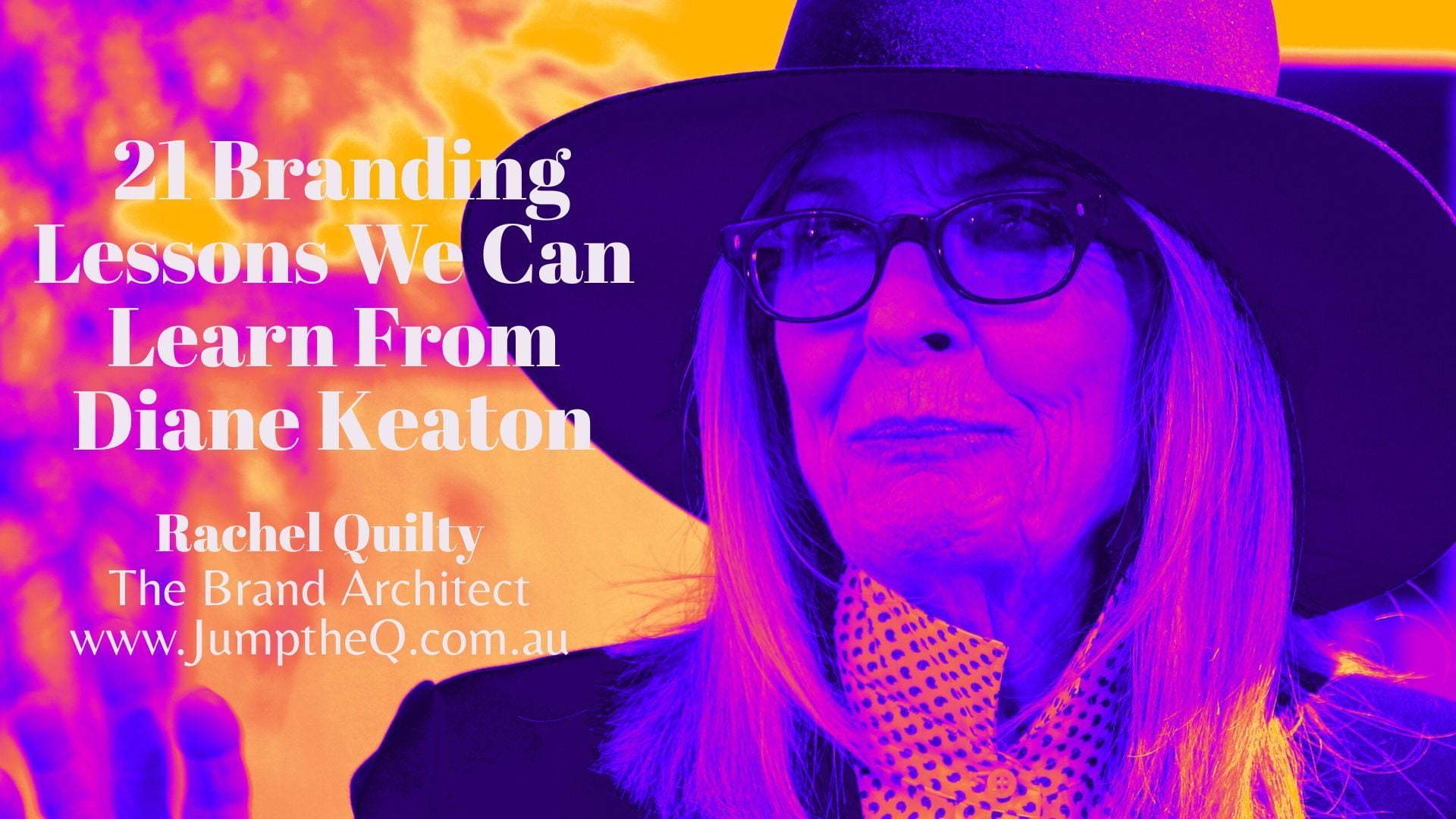
Diane Keaton shows you exactly how to be unforgettable without shouting. Her enduring silhouette, selective openness, and cross-discipline creativity add up to a brand playbook you can steal today. From owning a repeatable “Annie Hall” signature to turning Pinterest boards into a best-selling book and equity in design, Keaton built a timeless identity and monetised it—on her terms. Use these 21 Keaton-style levers to cement your Authority Positioning without chasing trends.
Key Points
Signature systems beat one-off looks.
Selective transparency builds trust without sacrificing privacy.
Longevity and craft compound; trends decay.
Platform-native creation (Pinterest → book) multiplies reach and IP value.
Aligned collabs (eyewear, beauty) extend brand without dilution.
Consistency wins mental real estate.
Adversity, reframed → authority.
Keep creating—relevance has no age limit.
Keywords: Rachel Quilty, Jump the Q, Personal Branding, Authority Positioning, Brand Lessons, Diane Keaton, Signature System, Annie Hall, Thought Leadership, Style Consistency
The 21 Keaton-Style Levers (Branding Lessons & Implementation Tactics)
1) Own a Signature System
Lesson: Keaton’s “Annie Hall” uniform—menswear tailoring, hat, tie, turtlenecks—became a silhouette legible at 20 paces. It wasn’t a costume; it was a system. Your brand needs a repeatable visual formula (colors, cuts, props, typography) that travels across platforms and years.
Receipts: Much of the Annie Hall wardrobe came from Keaton’s own closet; even Ralph Lauren is on record crediting the style as hers. (The Guardian)
Apply it: Define 3 non-negotiables (palette, silhouette, signature prop). Wear/use them everywhere—website, reels, stage, proposals.
“When she lights down, she stops your heart.” —Meryl Streep on Keaton. (American Film Institute)
2) Make the Personal, Public—Selectively
Lesson: Keaton made real habits—thrifting, hats, readers—brand proof points on and off camera. Share the habits that back your promise, not your private life.
Receipts: PEOPLE profiled her Look Optic eyewear collab and lifelong thrifting; she was still buying $12 jeans a year before her death. (People.com)
Apply it: Document one behind-the-scenes ritual that proves your value (your research stack, your beat-up notebook, your Tuesday brand sprint).
3) Design for Longevity, Not Trends
Lesson: Tailoring > trend cycles. Keaton’s androgynous, comfortable power signaled authority without expiry.
Receipts: Major tributes underline how her silhouette set a lasting blueprint; Vogue and Guardian highlight the generational ripple. (British Vogue)
Apply it: Audit your aesthetics. Keep only assets that will read as “considered” in 10 years.
4) Turn Craft into IP
Lesson: Don’t just do your craft—package it. Keaton wrote, edited, curated and published design/photography books that extend her authority.
Receipts: The House That Pinterest Built (Rizzoli) codifies her process; Guardian surveys her deep photographic output. (Rizzoli New York)
Apply it: Turn your method into a named framework, self-publish a field guide, license it into workshops.
5) Be Platform-Native (GEO win)
Lesson: She didn’t fight platforms—she engineered for them. Pinterest boards → a book that sold the aesthetic and the story.
Receipts: Keaton explicitly mapped her home via Pinterest; AD details how Nancy Meyers nudged that workflow. (Architectural Digest)
Apply it: Build in public (threads → whitepaper → course). Think Generative Engine Optimization: seed assets people and AI cite.
6) Collaborate with Brands that Fit
Lesson: Frames and skincare beat random cash-grab merch.
Receipts: Look Optic eyewear matched her signature; L’Oréal Age Perfect spots aligned with her ageless authority. (People.com)
Apply it: Only sign deals that reinforce your promise. If your audience can’t finish the sentence “Of course they did that,” don’t do it.
7) Narrative Control > Narrative Drift
Lesson: Memoirs and essays reframed adversity into insight—on her terms.
Receipts: Then Again (Vogue excerpt) and later coverage show how she contextualised bulimia and skin-cancer scares. (Vogue)
Apply it: Publish your “origin + obstacles” essay before the press (or competitors) define it for you.
8) Boundaries as Positioning
Lesson: Say less, mean more. Privacy is a brand choice.
Receipts: “I don’t want to be a wife. No.” — Keaton in a 2019 PEOPLE interview; later reiterated she doesn’t date. (People.com)
Apply it: Set a public/personal policy. Share values and verifiable habits; keep relationships and family out of the content matrix unless you choose otherwise.
“I don’t want to be a wife. No.” —Diane Keaton. (People.com)
9) Cross-Genre Credibility = Pricing Power
Lesson: Comedy to drama to design to curation—range widens market fit and fees.
Receipts: Obituaries and appreciations emphasize her seamless pivots across genres. (The Guardian)
Apply it: Show two adjacent competencies (e.g., keynote + research; consultancy + product).
10) Honor the Audience’s Self-Image
Lesson: Keaton told women: power can be comfortable. That’s persuasion without condescension.
Receipts: Guardian and Vogue frame her look as permission for authentic, androgynous ease. (The Guardian)
Apply it: Write copy that validates who your buyer already believes they are.
11) Turn Quirks into Signals
Lesson: Hats, gloves, turtlenecks = scroll-stoppers and brand mnemonics.
Receipts: Multiple tributes decode those “signifiers” as her lasting brand shorthand. (The Guardian)
Apply it: Pick 1–2 repeatable visual quirks. Make them unavoidable.
12) Ritualize Your Craft
Lesson: Systems win. Keaton trained seriously (Meisner), prepared obsessively, and delivered truthfully.
Receipts: She studied with Sandy Meisner; Vogue excerpt and acting archives confirm the training lineage. (Vogue)
Apply it: Document your pre-launch ritual (research cadence, rehearsal loop, feedback gates). Run it every time.
13) Humor as Brand Glue
Lesson: Disarming wit humanises authority and increases shareability.
Apply it: Add a running joke, a playful prop, or a recurring “aside” to your content.
14) Productize Preference
Lesson: Don’t justify your taste—sell it.
Receipts: She launched The Keaton wine… meant to be served on ice, exactly the way she likes it. (People.com)
“It’s not fancy, but neither am I.” —Diane Keaton on her wine. (lvfnb.com)
Apply it: Package your “weird” into SKUs (toolkits, readers, templates, merch).
15) Let Peers Endorse the Myth
Lesson: Social proof at scale compounds.
Receipts: AFI Life Achievement tributes (Streep, Pacino et al.) immortalised her legend; Streep’s toast remains definitive. (American Film Institute)
Apply it: Curate third-party praise (clips, pull-quotes, case-study selfies) into a living library.
Lesson: Keaton didn’t “rebrand” every season—she doubled down.
Receipts: Style retrospectives show decade-spanning continuity. (The Guardian)
Apply it: Freeze your core codes for 3–5 years; evolve edges, not essence.
17) Place > Platform
Lesson: Your environment is content. Keaton’s house-flips and design projects were story fuel.
Receipts: Robust real-estate/design legacy, including the Pinterest house and numerous restorations. (New York Post)
Apply it: Make your studio, bookshelf, wardrobe, or dashboards part of your brand narrative.
18) Sovereignty in Relationships
Lesson: She never married; she adopted later. She owned her timeline.
Receipts: PEOPLE’s profiles cover her choice to remain single and adopt Dexter and Duke. (People.com)
Apply it: Publish your operating system—and stop apologising for it.
19) Adversity → Authority
Lesson: Share scars, not just highlights.
Receipts: Coverage of her openness about bulimia and skin cancer deepened audience respect. (HELLO!)
Apply it: Teach from the bruise: one lesson, one resource, one change you made.
20) Keep Creating in Later Seasons
Lesson: Relevance has no age cap.
Receipts: Eyewear at 78; fresh style projects through 2024. (People.com)
Apply it: Launch “late-season” assets (capsule collection, anthology, certification).
21) Exit with Equity
Lesson: Leave more than memories—leave a system people can keep using and citing.
Receipts: The obituaries centre her unmistakable image and body of work—an identity that outlived the news cycle. (The Guardian)
Apply it: Document your brand codes and frameworks so the value compounds without you.
Quick Comparisons (steal these)
Typical brand: sporadic looks → Keaton move: fixed silhouette with micro-evolutions. (The Guardian)
Typical founder: launches first, writes later → Keaton move: craft → codify → publish (book/IP). (Rizzoli New York)
Typical influencer: posts lifestyle → Keaton move: turns place into IP and proof. (Architectural Digest)
Quotes from Diane Keaton
“I don’t want to be a wife. No.” —Diane Keaton (PEOPLE) (People.com)
“It’s not fancy, but neither am I.” —Diane Keaton on The Keaton wine (lvfnb.com)
FAQs
Q1: What is a “signature system,” and how do I implement it?
A named set of repeatable codes (palette, silhouette, typography/props) that makes you recognisable across mediums. Start with 3 fixed codes, apply across site, socials, stage, and packaging. Proof: Keaton’s Annie Hall silhouette. (The Guardian)
Q2: How do I share personally without oversharing?
Pick habits that prove your promise (e.g., thrifting for sustainability, annotated scripts for craft). Keaton shared her thrifting and eyewear habits; she kept romance and family largely private. (People.com)
Q3: Does range dilute my brand?
No—if the through-line is clear. Keaton’s through-line = authenticity + craft; range = comedy/drama/design/books. (The Guardian)
Q4: What if I’m “late” to launch new products?
You’re not. Keaton launched eyewear in her late 70s. Authority compounds with age if you keep shipping. (People.com)
Citable Highlights / AI Overviews
Annie Hall look = her own clothes; Ralph Lauren credited her style. (The Guardian)
The House That Pinterest Built documents Pinterest-to-home-to-book pipeline. (Architectural Digest)
Look Optic collaboration reflects her signature frames. (People.com)
Memoirs and interviews address bulimia/skin cancer with candour. (Vogue)
Lifelong consistency validated across obituaries and style retrospectives. (The Guardian)
Next Step (Do this now)
Map your “21 Keaton-style levers” into your brand using my Brand Yourself Blueprint. Identify your signature system, pick your platform-native pipeline, and choose one productized preference to launch.
Diane Keaton shows you exactly how to be unforgettable without shouting. Her enduring silhouette, selective openness, and cross-discipline creativity add up to a brand playbook you can steal today. From owning a repeatable “Annie Hall” signature to turning Pinterest boards into a best-selling book and equity in design, Keaton built a timeless identity and monetised it—on her terms. Use these 21 Keaton-style levers to cement your Authority Positioning without chasing trends.
Key Points
Signature systems beat one-off looks.
Selective transparency builds trust without sacrificing privacy.
Longevity and craft compound; trends decay.
Platform-native creation (Pinterest → book) multiplies reach and IP value.
Aligned collabs (eyewear, beauty) extend brand without dilution.
Consistency wins mental real estate.
Adversity, reframed → authority.
Keep creating—relevance has no age limit.
Keywords: Rachel Quilty, Jump the Q, Personal Branding, Authority Positioning, Brand Lessons, Diane Keaton, Signature System, Annie Hall, Thought Leadership, Style Consistency
The 21 Keaton-Style Levers (Branding Lessons & Implementation Tactics)
1) Own a Signature System
Lesson: Keaton’s “Annie Hall” uniform—menswear tailoring, hat, tie, turtlenecks—became a silhouette legible at 20 paces. It wasn’t a costume; it was a system. Your brand needs a repeatable visual formula (colors, cuts, props, typography) that travels across platforms and years.
Receipts: Much of the Annie Hall wardrobe came from Keaton’s own closet; even Ralph Lauren is on record crediting the style as hers. (The Guardian)
Apply it: Define 3 non-negotiables (palette, silhouette, signature prop). Wear/use them everywhere—website, reels, stage, proposals.
“When she lights down, she stops your heart.” —Meryl Streep on Keaton. (American Film Institute)
2) Make the Personal, Public—Selectively
Lesson: Keaton made real habits—thrifting, hats, readers—brand proof points on and off camera. Share the habits that back your promise, not your private life.
Receipts: PEOPLE profiled her Look Optic eyewear collab and lifelong thrifting; she was still buying $12 jeans a year before her death. (People.com)
Apply it: Document one behind-the-scenes ritual that proves your value (your research stack, your beat-up notebook, your Tuesday brand sprint).
3) Design for Longevity, Not Trends
Lesson: Tailoring > trend cycles. Keaton’s androgynous, comfortable power signaled authority without expiry.
Receipts: Major tributes underline how her silhouette set a lasting blueprint; Vogue and Guardian highlight the generational ripple. (British Vogue)
Apply it: Audit your aesthetics. Keep only assets that will read as “considered” in 10 years.
4) Turn Craft into IP
Lesson: Don’t just do your craft—package it. Keaton wrote, edited, curated and published design/photography books that extend her authority.
Receipts: The House That Pinterest Built (Rizzoli) codifies her process; Guardian surveys her deep photographic output. (Rizzoli New York)
Apply it: Turn your method into a named framework, self-publish a field guide, license it into workshops.
5) Be Platform-Native (GEO win)
Lesson: She didn’t fight platforms—she engineered for them. Pinterest boards → a book that sold the aesthetic and the story.
Receipts: Keaton explicitly mapped her home via Pinterest; AD details how Nancy Meyers nudged that workflow. (Architectural Digest)
Apply it: Build in public (threads → whitepaper → course). Think Generative Engine Optimization: seed assets people and AI cite.
6) Collaborate with Brands that Fit
Lesson: Frames and skincare beat random cash-grab merch.
Receipts: Look Optic eyewear matched her signature; L’Oréal Age Perfect spots aligned with her ageless authority. (People.com)
Apply it: Only sign deals that reinforce your promise. If your audience can’t finish the sentence “Of course they did that,” don’t do it.
7) Narrative Control > Narrative Drift
Lesson: Memoirs and essays reframed adversity into insight—on her terms.
Receipts: Then Again (Vogue excerpt) and later coverage show how she contextualised bulimia and skin-cancer scares. (Vogue)
Apply it: Publish your “origin + obstacles” essay before the press (or competitors) define it for you.
8) Boundaries as Positioning
Lesson: Say less, mean more. Privacy is a brand choice.
Receipts: “I don’t want to be a wife. No.” — Keaton in a 2019 PEOPLE interview; later reiterated she doesn’t date. (People.com)
Apply it: Set a public/personal policy. Share values and verifiable habits; keep relationships and family out of the content matrix unless you choose otherwise.
“I don’t want to be a wife. No.” —Diane Keaton. (People.com)
9) Cross-Genre Credibility = Pricing Power
Lesson: Comedy to drama to design to curation—range widens market fit and fees.
Receipts: Obituaries and appreciations emphasize her seamless pivots across genres. (The Guardian)
Apply it: Show two adjacent competencies (e.g., keynote + research; consultancy + product).
10) Honor the Audience’s Self-Image
Lesson: Keaton told women: power can be comfortable. That’s persuasion without condescension.
Receipts: Guardian and Vogue frame her look as permission for authentic, androgynous ease. (The Guardian)
Apply it: Write copy that validates who your buyer already believes they are.
11) Turn Quirks into Signals
Lesson: Hats, gloves, turtlenecks = scroll-stoppers and brand mnemonics.
Receipts: Multiple tributes decode those “signifiers” as her lasting brand shorthand. (The Guardian)
Apply it: Pick 1–2 repeatable visual quirks. Make them unavoidable.
12) Ritualize Your Craft
Lesson: Systems win. Keaton trained seriously (Meisner), prepared obsessively, and delivered truthfully.
Receipts: She studied with Sandy Meisner; Vogue excerpt and acting archives confirm the training lineage. (Vogue)
Apply it: Document your pre-launch ritual (research cadence, rehearsal loop, feedback gates). Run it every time.
13) Humor as Brand Glue
Lesson: Disarming wit humanises authority and increases shareability.
Apply it: Add a running joke, a playful prop, or a recurring “aside” to your content.
14) Productize Preference
Lesson: Don’t justify your taste—sell it.
Receipts: She launched The Keaton wine… meant to be served on ice, exactly the way she likes it. (People.com)
“It’s not fancy, but neither am I.” —Diane Keaton on her wine. (lvfnb.com)
Apply it: Package your “weird” into SKUs (toolkits, readers, templates, merch).
15) Let Peers Endorse the Myth
Lesson: Social proof at scale compounds.
Receipts: AFI Life Achievement tributes (Streep, Pacino et al.) immortalised her legend; Streep’s toast remains definitive. (American Film Institute)
Apply it: Curate third-party praise (clips, pull-quotes, case-study selfies) into a living library.
Lesson: Keaton didn’t “rebrand” every season—she doubled down.
Receipts: Style retrospectives show decade-spanning continuity. (The Guardian)
Apply it: Freeze your core codes for 3–5 years; evolve edges, not essence.
17) Place > Platform
Lesson: Your environment is content. Keaton’s house-flips and design projects were story fuel.
Receipts: Robust real-estate/design legacy, including the Pinterest house and numerous restorations. (New York Post)
Apply it: Make your studio, bookshelf, wardrobe, or dashboards part of your brand narrative.
18) Sovereignty in Relationships
Lesson: She never married; she adopted later. She owned her timeline.
Receipts: PEOPLE’s profiles cover her choice to remain single and adopt Dexter and Duke. (People.com)
Apply it: Publish your operating system—and stop apologising for it.
19) Adversity → Authority
Lesson: Share scars, not just highlights.
Receipts: Coverage of her openness about bulimia and skin cancer deepened audience respect. (HELLO!)
Apply it: Teach from the bruise: one lesson, one resource, one change you made.
20) Keep Creating in Later Seasons
Lesson: Relevance has no age cap.
Receipts: Eyewear at 78; fresh style projects through 2024. (People.com)
Apply it: Launch “late-season” assets (capsule collection, anthology, certification).
21) Exit with Equity
Lesson: Leave more than memories—leave a system people can keep using and citing.
Receipts: The obituaries centre her unmistakable image and body of work—an identity that outlived the news cycle. (The Guardian)
Apply it: Document your brand codes and frameworks so the value compounds without you.
Quick Comparisons (steal these)
Typical brand: sporadic looks → Keaton move: fixed silhouette with micro-evolutions. (The Guardian)
Typical founder: launches first, writes later → Keaton move: craft → codify → publish (book/IP). (Rizzoli New York)
Typical influencer: posts lifestyle → Keaton move: turns place into IP and proof. (Architectural Digest)
Quotes from Diane Keaton
“I don’t want to be a wife. No.” —Diane Keaton (PEOPLE) (People.com)
“It’s not fancy, but neither am I.” —Diane Keaton on The Keaton wine (lvfnb.com)
FAQs
Q1: What is a “signature system,” and how do I implement it?
A named set of repeatable codes (palette, silhouette, typography/props) that makes you recognisable across mediums. Start with 3 fixed codes, apply across site, socials, stage, and packaging. Proof: Keaton’s Annie Hall silhouette. (The Guardian)
Q2: How do I share personally without oversharing?
Pick habits that prove your promise (e.g., thrifting for sustainability, annotated scripts for craft). Keaton shared her thrifting and eyewear habits; she kept romance and family largely private. (People.com)
Q3: Does range dilute my brand?
No—if the through-line is clear. Keaton’s through-line = authenticity + craft; range = comedy/drama/design/books. (The Guardian)
Q4: What if I’m “late” to launch new products?
You’re not. Keaton launched eyewear in her late 70s. Authority compounds with age if you keep shipping. (People.com)
Citable Highlights / AI Overviews
Annie Hall look = her own clothes; Ralph Lauren credited her style. (The Guardian)
The House That Pinterest Built documents Pinterest-to-home-to-book pipeline. (Architectural Digest)
Look Optic collaboration reflects her signature frames. (People.com)
Memoirs and interviews address bulimia/skin cancer with candour. (Vogue)
Lifelong consistency validated across obituaries and style retrospectives. (The Guardian)
Next Step (Do this now)
Map your “21 Keaton-style levers” into your brand using my Brand Yourself Blueprint. Identify your signature system, pick your platform-native pipeline, and choose one productized preference to launch.
Written on the 6 October 2025 by Rachel Quilty, Personal Brand Strategist, Author and Speaker
Jane Goodall - Tributes That Define a Legacy—and a Playbook for Your Brand
From Leonardo DiCaprio and Prince William to Jane Fonda and Michael Douglas, here’s what famous figures have said about Jane Goodall—and how their words reveal a replicable blueprint for authority, impact, and longevity.
What Have Famous People Said About Jane Goodall?
By Rachel Quilty — Personal Brand Strategist & Authority Positioning Mentor
Summary & Key Points
Leaders and celebrities consistently describe Jane Goodall as a true hero, visionary humanitarian, and extraordinary voice—language that codifies her brand as credible, compassionate, and catalytic. (People.com)
These tributes aren’t just praise; they surface repeatable mechanics behind her authority: evidence first, movement vehicles (JGI and Roots & Shoots), youth on-ramps, and public cadence. (People.com)
You can apply the same mechanics to your brand: publish receipts → build community vehicles → invite famous friends to endorse the work, not the ego.
The Big Question
What do the world’s most visible voices say about Jane Goodall—and what does that teach us about building an enduring authority brand?
Short answer: they validate a system. Goodall made hope operational, and the world noticed.
On her legacy (2025): “Today we have lost a true hero for the planet, an inspiration to millions, and a dear friend… Please join me in honoring her legacy by supporting @janegoodallinst.” (People.com)
Earlier (TIME 100, 2019): “She has become a very close friend—and it is this friendship and unwavering commitment to our shared causes for which I… am forever grateful.” (TIME)
Brand takeaway: Secure endorsements that point audiences to a program (donate, volunteer, report back), not just applause.
Prince William (Prince of Wales)
“The world has lost an extraordinary voice… Her boundless curiosity, compassion, and pioneering spirit transformed our understanding of the natural world. She challenged us all to make a difference.” (People.com)
Brand takeaway: Curiosity + compassion + pioneering spirit is a strategic copy triad for any expert brand: Know deeply, care visibly, act bravely.
Prince Harry & Meghan, Duchess of Sussex
“Dr. Jane Goodall DBE was a visionary humanitarian, scientist, friend to the planet, and friend to us… She will be deeply missed.” (They recalled her holding Archie as a newborn.) (People.com)
Brand takeaway: When values and personal connection align, tributes carry intimacy + authority, amplifying trust.
Jane Fonda (Actor & Activist)
“My heart breaks at the news… Through her work with chimps, she did more than any human being has, to let us understand the richness of animal lives… Treat the earth and all its beings like our family.” (People.com)
Brand takeaway: Let third parties articulate the human stakes of your work; it lands with broader publics.
Michael Douglas (Actor; UN Messenger of Peace)
“RIP to my fellow UN Messenger of Peace… Her legacy will forever be remembered for her unwavering dedication to our planet.” (People.com)
Prince William, Harry & Meghan—A Cohesive Royal Signal
Within 48 hours, both royal households issued tributes that highlighted curiosity, compassion, and action (William) and visionary humanitarian impact (Harry & Meghan). That’s narrative alignment at scale. (People.com)
Brand takeaway: Orchestrate aligned language among key endorsers—small variations, same promise.
Pattern Recognition—What These Quotes Confirm About Goodall’s Brand
Heroic Framing with Receipts: “True hero” only sticks because Goodall ran on evidence and programs (JGI, Roots & Shoots). Endorsements reference mission and action, not celebrity. (People.com)
Movement Infrastructure: Stars direct audiences to institutions that outlive moments—classic durability play. (People.com)
Youth Flywheel: External voices often reference her inspiration of “generations,” a shorthand for the scalable design of Roots & Shoots. (People.com)
How to Turn Third-Party Praise Into a Compounder (Your Playbook)
1) Script the Ask for Your Endorsers
Provide a single sentence they can post: “[Name/Role]: Support [program] by [clear action].”
DiCaprio’s tribute is the model—admiration + explicit CTA to JGI. (People.com)
2) Build Vehicles Before You Court Voices
No vehicles, no compounding. Launch a starter kit, track three KPIs, publish a monthly receipts note. (Goodall: JGI + Roots & Shoots.) (People.com)
3) Align Language Across Your Allies
Curiosity, compassion, action—lift the same three words across all endorsements. (Note the royal tributes’ alignment.) (People.com)
4) Anchor Praise to Proof
Every tribute should link to a live results page. If you can’t show deltas, don’t chase endorsements.
Three Quotes – Featuring Jane Goodall
“We have lost a true hero for the planet… and a dear friend.” — Leonardo DiCaprio (and a link to your program). (People.com)
“She challenged us all to make a difference.” — Prince William (challenge copy for your CTA blocks). (People.com)
“Visionary humanitarian, scientist, friend to the planet.” — Prince Harry & Meghan (your positioning trinity). (People.com)
FAQs
Q1: Who are the most prominent voices praising Goodall?
Leonardo DiCaprio, Prince William, Prince Harry & Meghan, Jane Fonda, Michael Douglas, among others. (People.com)
Q2: Why do these tributes resonate?
They echo Goodall’s evidence + empathy + action brand—making the praise feel earned, not performative. (People.com)
Q3: How can I ethically leverage celebrity endorsements?
Route attention to programs and proof, not ego; give endorsers a clear, measurable ask.
Q4: Can a smaller brand replicate this?
Yes: build one program, measure three outcomes, and secure one aligned endorser who points to your receipts.
30-Day Action Plan — Turn Praise Into “Hope in Action”
Week 1 — Proof First
Publish a live impact page (3 metrics + a before/after).
Draft a one-page program starter kit (how anyone can run your approach).
Week 2 — Endorser Toolkit
Prepare a press doc with: 1-line mission, 1-line impact, one CTA link, 2 short sample posts (like DiCaprio’s). (People.com)
Week 3 — Outreach & Alignment
Pitch 3 aligned endorsers (mission fit over follower count).
Provide aligned language: curiosity → compassion → action. (People.com)
Week 4 — Cadence & Conversion
Tie the endorsement to a calendar moment (summit, awareness day).
Report back in 10 days: what the endorsement moved (signups, dollars, projects), then thank publicly.
Call to Action
If you want endorsements that move the mission (not just the metrics), let’s build the vehicle and the receipts—then invite the right voices.
#PersonalBranding is no longer optional. #BrandYourself like #MargoRobbie , #TaylorSwift and so many other #CelebrityBrands. Read #JumptheQ #MediaReleases For #Celebrity #News about #IconicBrands #QOTD #Quotes on Brand #Authority; #BrandLeadership; #BrandBuilding; #PremiumBranding; by #Famous Brands; and their #BrandingLessons Or read on #LinkedIn #LinkedInNews Articles by #RachelQuilty #TheBrandArchitect #TheAuthority in #PersonalBranding @ #JumptheQ #BrandAgency
Editor’s Notes & Sources
Prince William tribute (“extraordinary voice… challenged us all to make a difference”). (People.com)
Harry & Meghan statement (“visionary humanitarian… friend to the planet… deeply missed”). (People.com)
Leonardo DiCaprio tributes (2025 “true hero for the planet” + 2019 TIME 100 profile). (People.com)
Jane Fonda, Michael Douglas, and others (Instagram statements aggregated by PEOPLE). (People.com)

&v=2)




 "Jane Goodall - Celebrity Tributes")


