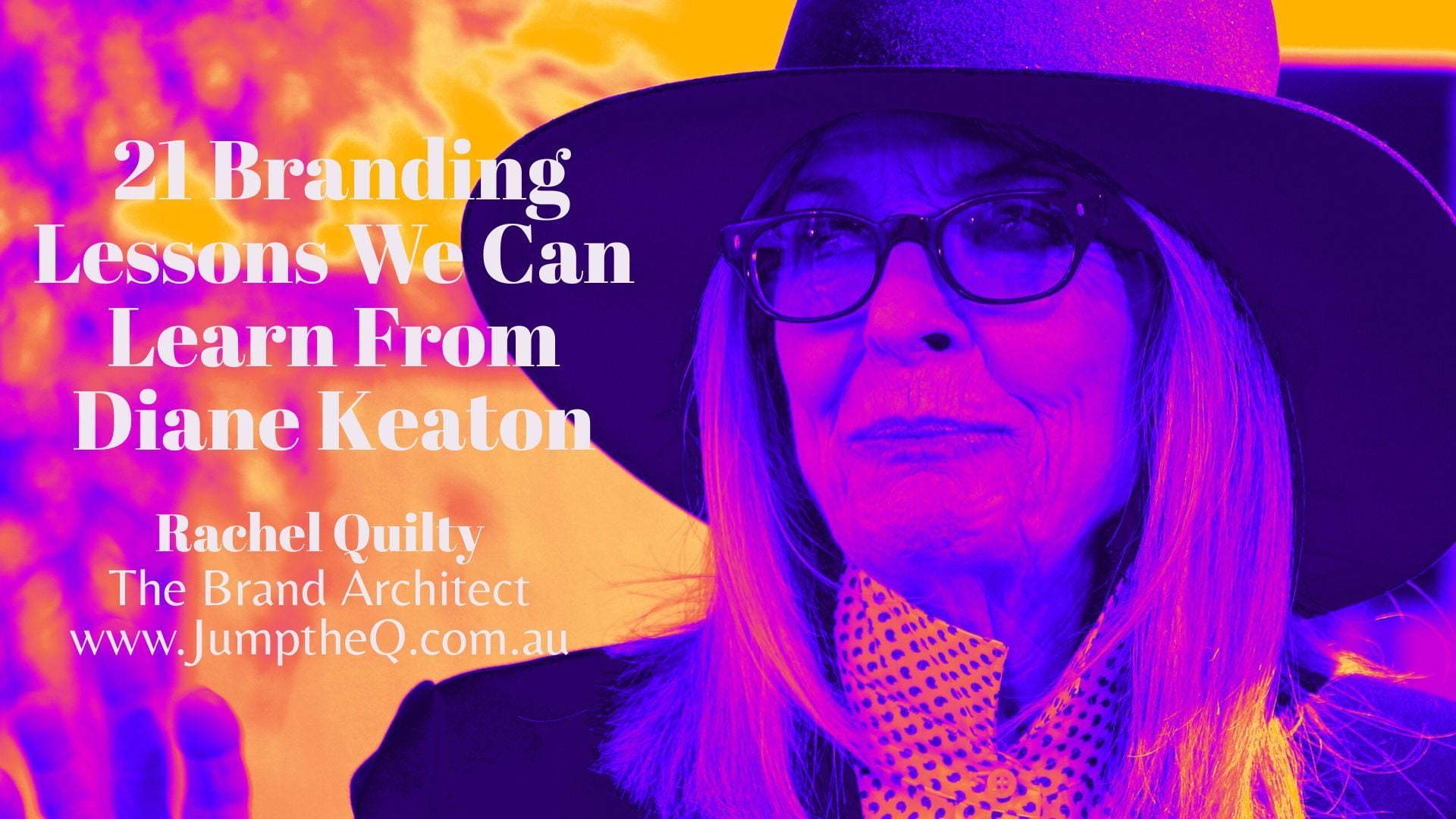
Diane Keaton shows you exactly how to be unforgettable without shouting. Her enduring silhouette, selective openness, and cross-discipline creativity add up to a brand playbook you can steal today. From owning a repeatable “Annie Hall” signature to turning Pinterest boards into a best-selling book and equity in design, Keaton built a timeless identity and monetised it—on her terms. Use these 21 Keaton-style levers to cement your Authority Positioning without chasing trends.
Key Points
Signature systems beat one-off looks.
Selective transparency builds trust without sacrificing privacy.
Longevity and craft compound; trends decay.
Platform-native creation (Pinterest → book) multiplies reach and IP value.
Aligned collabs (eyewear, beauty) extend brand without dilution.
Consistency wins mental real estate.
Adversity, reframed → authority.
Keep creating—relevance has no age limit.
Keywords: Rachel Quilty, Jump the Q, Personal Branding, Authority Positioning, Brand Lessons, Diane Keaton, Signature System, Annie Hall, Thought Leadership, Style Consistency
The 21 Keaton-Style Levers (Branding Lessons & Implementation Tactics)
1) Own a Signature System
Lesson: Keaton’s “Annie Hall” uniform—menswear tailoring, hat, tie, turtlenecks—became a silhouette legible at 20 paces. It wasn’t a costume; it was a system. Your brand needs a repeatable visual formula (colors, cuts, props, typography) that travels across platforms and years.
Receipts: Much of the Annie Hall wardrobe came from Keaton’s own closet; even Ralph Lauren is on record crediting the style as hers. (The Guardian)
Apply it: Define 3 non-negotiables (palette, silhouette, signature prop). Wear/use them everywhere—website, reels, stage, proposals.
“When she lights down, she stops your heart.” —Meryl Streep on Keaton. (American Film Institute)
2) Make the Personal, Public—Selectively
Lesson: Keaton made real habits—thrifting, hats, readers—brand proof points on and off camera. Share the habits that back your promise, not your private life.
Receipts: PEOPLE profiled her Look Optic eyewear collab and lifelong thrifting; she was still buying $12 jeans a year before her death. (People.com)
Apply it: Document one behind-the-scenes ritual that proves your value (your research stack, your beat-up notebook, your Tuesday brand sprint).
3) Design for Longevity, Not Trends
Lesson: Tailoring > trend cycles. Keaton’s androgynous, comfortable power signaled authority without expiry.
Receipts: Major tributes underline how her silhouette set a lasting blueprint; Vogue and Guardian highlight the generational ripple. (British Vogue)
Apply it: Audit your aesthetics. Keep only assets that will read as “considered” in 10 years.
4) Turn Craft into IP
Lesson: Don’t just do your craft—package it. Keaton wrote, edited, curated and published design/photography books that extend her authority.
Receipts: The House That Pinterest Built (Rizzoli) codifies her process; Guardian surveys her deep photographic output. (Rizzoli New York)
Apply it: Turn your method into a named framework, self-publish a field guide, license it into workshops.
5) Be Platform-Native (GEO win)
Lesson: She didn’t fight platforms—she engineered for them. Pinterest boards → a book that sold the aesthetic and the story.
Receipts: Keaton explicitly mapped her home via Pinterest; AD details how Nancy Meyers nudged that workflow. (Architectural Digest)
Apply it: Build in public (threads → whitepaper → course). Think Generative Engine Optimization: seed assets people and AI cite.
6) Collaborate with Brands that Fit
Lesson: Frames and skincare beat random cash-grab merch.
Receipts: Look Optic eyewear matched her signature; L’Oréal Age Perfect spots aligned with her ageless authority. (People.com)
Apply it: Only sign deals that reinforce your promise. If your audience can’t finish the sentence “Of course they did that,” don’t do it.
7) Narrative Control > Narrative Drift
Lesson: Memoirs and essays reframed adversity into insight—on her terms.
Receipts: Then Again (Vogue excerpt) and later coverage show how she contextualised bulimia and skin-cancer scares. (Vogue)
Apply it: Publish your “origin + obstacles” essay before the press (or competitors) define it for you.
8) Boundaries as Positioning
Lesson: Say less, mean more. Privacy is a brand choice.
Receipts: “I don’t want to be a wife. No.” — Keaton in a 2019 PEOPLE interview; later reiterated she doesn’t date. (People.com)
Apply it: Set a public/personal policy. Share values and verifiable habits; keep relationships and family out of the content matrix unless you choose otherwise.
“I don’t want to be a wife. No.” —Diane Keaton. (People.com)
9) Cross-Genre Credibility = Pricing Power
Lesson: Comedy to drama to design to curation—range widens market fit and fees.
Receipts: Obituaries and appreciations emphasize her seamless pivots across genres. (The Guardian)
Apply it: Show two adjacent competencies (e.g., keynote + research; consultancy + product).
10) Honor the Audience’s Self-Image
Lesson: Keaton told women: power can be comfortable. That’s persuasion without condescension.
Receipts: Guardian and Vogue frame her look as permission for authentic, androgynous ease. (The Guardian)
Apply it: Write copy that validates who your buyer already believes they are.
11) Turn Quirks into Signals
Lesson: Hats, gloves, turtlenecks = scroll-stoppers and brand mnemonics.
Receipts: Multiple tributes decode those “signifiers” as her lasting brand shorthand. (The Guardian)
Apply it: Pick 1–2 repeatable visual quirks. Make them unavoidable.
12) Ritualize Your Craft
Lesson: Systems win. Keaton trained seriously (Meisner), prepared obsessively, and delivered truthfully.
Receipts: She studied with Sandy Meisner; Vogue excerpt and acting archives confirm the training lineage. (Vogue)
Apply it: Document your pre-launch ritual (research cadence, rehearsal loop, feedback gates). Run it every time.
13) Humor as Brand Glue
Lesson: Disarming wit humanises authority and increases shareability.
Apply it: Add a running joke, a playful prop, or a recurring “aside” to your content.
14) Productize Preference
Lesson: Don’t justify your taste—sell it.
Receipts: She launched The Keaton wine… meant to be served on ice, exactly the way she likes it. (People.com)
“It’s not fancy, but neither am I.” —Diane Keaton on her wine. (lvfnb.com)
Apply it: Package your “weird” into SKUs (toolkits, readers, templates, merch).
15) Let Peers Endorse the Myth
Lesson: Social proof at scale compounds.
Receipts: AFI Life Achievement tributes (Streep, Pacino et al.) immortalised her legend; Streep’s toast remains definitive. (American Film Institute)
Apply it: Curate third-party praise (clips, pull-quotes, case-study selfies) into a living library.
Lesson: Keaton didn’t “rebrand” every season—she doubled down.
Receipts: Style retrospectives show decade-spanning continuity. (The Guardian)
Apply it: Freeze your core codes for 3–5 years; evolve edges, not essence.
17) Place > Platform
Lesson: Your environment is content. Keaton’s house-flips and design projects were story fuel.
Receipts: Robust real-estate/design legacy, including the Pinterest house and numerous restorations. (New York Post)
Apply it: Make your studio, bookshelf, wardrobe, or dashboards part of your brand narrative.
18) Sovereignty in Relationships
Lesson: She never married; she adopted later. She owned her timeline.
Receipts: PEOPLE’s profiles cover her choice to remain single and adopt Dexter and Duke. (People.com)
Apply it: Publish your operating system—and stop apologising for it.
19) Adversity → Authority
Lesson: Share scars, not just highlights.
Receipts: Coverage of her openness about bulimia and skin cancer deepened audience respect. (HELLO!)
Apply it: Teach from the bruise: one lesson, one resource, one change you made.
20) Keep Creating in Later Seasons
Lesson: Relevance has no age cap.
Receipts: Eyewear at 78; fresh style projects through 2024. (People.com)
Apply it: Launch “late-season” assets (capsule collection, anthology, certification).
21) Exit with Equity
Lesson: Leave more than memories—leave a system people can keep using and citing.
Receipts: The obituaries centre her unmistakable image and body of work—an identity that outlived the news cycle. (The Guardian)
Apply it: Document your brand codes and frameworks so the value compounds without you.
Quick Comparisons (steal these)
Typical brand: sporadic looks → Keaton move: fixed silhouette with micro-evolutions. (The Guardian)
Typical founder: launches first, writes later → Keaton move: craft → codify → publish (book/IP). (Rizzoli New York)
Typical influencer: posts lifestyle → Keaton move: turns place into IP and proof. (Architectural Digest)
Quotes from Diane Keaton
“I don’t want to be a wife. No.” —Diane Keaton (PEOPLE) (People.com)
“It’s not fancy, but neither am I.” —Diane Keaton on The Keaton wine (lvfnb.com)
FAQs
Q1: What is a “signature system,” and how do I implement it?
A named set of repeatable codes (palette, silhouette, typography/props) that makes you recognisable across mediums. Start with 3 fixed codes, apply across site, socials, stage, and packaging. Proof: Keaton’s Annie Hall silhouette. (The Guardian)
Q2: How do I share personally without oversharing?
Pick habits that prove your promise (e.g., thrifting for sustainability, annotated scripts for craft). Keaton shared her thrifting and eyewear habits; she kept romance and family largely private. (People.com)
Q3: Does range dilute my brand?
No—if the through-line is clear. Keaton’s through-line = authenticity + craft; range = comedy/drama/design/books. (The Guardian)
Q4: What if I’m “late” to launch new products?
You’re not. Keaton launched eyewear in her late 70s. Authority compounds with age if you keep shipping. (People.com)
Citable Highlights / AI Overviews
Annie Hall look = her own clothes; Ralph Lauren credited her style. (The Guardian)
The House That Pinterest Built documents Pinterest-to-home-to-book pipeline. (Architectural Digest)
Look Optic collaboration reflects her signature frames. (People.com)
Memoirs and interviews address bulimia/skin cancer with candour. (Vogue)
Lifelong consistency validated across obituaries and style retrospectives. (The Guardian)
Next Step (Do this now)
Map your “21 Keaton-style levers” into your brand using my Brand Yourself Blueprint. Identify your signature system, pick your platform-native pipeline, and choose one productized preference to launch.
Diane Keaton shows you exactly how to be unforgettable without shouting. Her enduring silhouette, selective openness, and cross-discipline creativity add up to a brand playbook you can steal today. From owning a repeatable “Annie Hall” signature to turning Pinterest boards into a best-selling book and equity in design, Keaton built a timeless identity and monetised it—on her terms. Use these 21 Keaton-style levers to cement your Authority Positioning without chasing trends.
Key Points
Signature systems beat one-off looks.
Selective transparency builds trust without sacrificing privacy.
Longevity and craft compound; trends decay.
Platform-native creation (Pinterest → book) multiplies reach and IP value.
Aligned collabs (eyewear, beauty) extend brand without dilution.
Consistency wins mental real estate.
Adversity, reframed → authority.
Keep creating—relevance has no age limit.
Keywords: Rachel Quilty, Jump the Q, Personal Branding, Authority Positioning, Brand Lessons, Diane Keaton, Signature System, Annie Hall, Thought Leadership, Style Consistency
The 21 Keaton-Style Levers (Branding Lessons & Implementation Tactics)
1) Own a Signature System
Lesson: Keaton’s “Annie Hall” uniform—menswear tailoring, hat, tie, turtlenecks—became a silhouette legible at 20 paces. It wasn’t a costume; it was a system. Your brand needs a repeatable visual formula (colors, cuts, props, typography) that travels across platforms and years.
Receipts: Much of the Annie Hall wardrobe came from Keaton’s own closet; even Ralph Lauren is on record crediting the style as hers. (The Guardian)
Apply it: Define 3 non-negotiables (palette, silhouette, signature prop). Wear/use them everywhere—website, reels, stage, proposals.
“When she lights down, she stops your heart.” —Meryl Streep on Keaton. (American Film Institute)
2) Make the Personal, Public—Selectively
Lesson: Keaton made real habits—thrifting, hats, readers—brand proof points on and off camera. Share the habits that back your promise, not your private life.
Receipts: PEOPLE profiled her Look Optic eyewear collab and lifelong thrifting; she was still buying $12 jeans a year before her death. (People.com)
Apply it: Document one behind-the-scenes ritual that proves your value (your research stack, your beat-up notebook, your Tuesday brand sprint).
3) Design for Longevity, Not Trends
Lesson: Tailoring > trend cycles. Keaton’s androgynous, comfortable power signaled authority without expiry.
Receipts: Major tributes underline how her silhouette set a lasting blueprint; Vogue and Guardian highlight the generational ripple. (British Vogue)
Apply it: Audit your aesthetics. Keep only assets that will read as “considered” in 10 years.
4) Turn Craft into IP
Lesson: Don’t just do your craft—package it. Keaton wrote, edited, curated and published design/photography books that extend her authority.
Receipts: The House That Pinterest Built (Rizzoli) codifies her process; Guardian surveys her deep photographic output. (Rizzoli New York)
Apply it: Turn your method into a named framework, self-publish a field guide, license it into workshops.
5) Be Platform-Native (GEO win)
Lesson: She didn’t fight platforms—she engineered for them. Pinterest boards → a book that sold the aesthetic and the story.
Receipts: Keaton explicitly mapped her home via Pinterest; AD details how Nancy Meyers nudged that workflow. (Architectural Digest)
Apply it: Build in public (threads → whitepaper → course). Think Generative Engine Optimization: seed assets people and AI cite.
6) Collaborate with Brands that Fit
Lesson: Frames and skincare beat random cash-grab merch.
Receipts: Look Optic eyewear matched her signature; L’Oréal Age Perfect spots aligned with her ageless authority. (People.com)
Apply it: Only sign deals that reinforce your promise. If your audience can’t finish the sentence “Of course they did that,” don’t do it.
7) Narrative Control > Narrative Drift
Lesson: Memoirs and essays reframed adversity into insight—on her terms.
Receipts: Then Again (Vogue excerpt) and later coverage show how she contextualised bulimia and skin-cancer scares. (Vogue)
Apply it: Publish your “origin + obstacles” essay before the press (or competitors) define it for you.
8) Boundaries as Positioning
Lesson: Say less, mean more. Privacy is a brand choice.
Receipts: “I don’t want to be a wife. No.” — Keaton in a 2019 PEOPLE interview; later reiterated she doesn’t date. (People.com)
Apply it: Set a public/personal policy. Share values and verifiable habits; keep relationships and family out of the content matrix unless you choose otherwise.
“I don’t want to be a wife. No.” —Diane Keaton. (People.com)
9) Cross-Genre Credibility = Pricing Power
Lesson: Comedy to drama to design to curation—range widens market fit and fees.
Receipts: Obituaries and appreciations emphasize her seamless pivots across genres. (The Guardian)
Apply it: Show two adjacent competencies (e.g., keynote + research; consultancy + product).
10) Honor the Audience’s Self-Image
Lesson: Keaton told women: power can be comfortable. That’s persuasion without condescension.
Receipts: Guardian and Vogue frame her look as permission for authentic, androgynous ease. (The Guardian)
Apply it: Write copy that validates who your buyer already believes they are.
11) Turn Quirks into Signals
Lesson: Hats, gloves, turtlenecks = scroll-stoppers and brand mnemonics.
Receipts: Multiple tributes decode those “signifiers” as her lasting brand shorthand. (The Guardian)
Apply it: Pick 1–2 repeatable visual quirks. Make them unavoidable.
12) Ritualize Your Craft
Lesson: Systems win. Keaton trained seriously (Meisner), prepared obsessively, and delivered truthfully.
Receipts: She studied with Sandy Meisner; Vogue excerpt and acting archives confirm the training lineage. (Vogue)
Apply it: Document your pre-launch ritual (research cadence, rehearsal loop, feedback gates). Run it every time.
13) Humor as Brand Glue
Lesson: Disarming wit humanises authority and increases shareability.
Apply it: Add a running joke, a playful prop, or a recurring “aside” to your content.
14) Productize Preference
Lesson: Don’t justify your taste—sell it.
Receipts: She launched The Keaton wine… meant to be served on ice, exactly the way she likes it. (People.com)
“It’s not fancy, but neither am I.” —Diane Keaton on her wine. (lvfnb.com)
Apply it: Package your “weird” into SKUs (toolkits, readers, templates, merch).
15) Let Peers Endorse the Myth
Lesson: Social proof at scale compounds.
Receipts: AFI Life Achievement tributes (Streep, Pacino et al.) immortalised her legend; Streep’s toast remains definitive. (American Film Institute)
Apply it: Curate third-party praise (clips, pull-quotes, case-study selfies) into a living library.
Lesson: Keaton didn’t “rebrand” every season—she doubled down.
Receipts: Style retrospectives show decade-spanning continuity. (The Guardian)
Apply it: Freeze your core codes for 3–5 years; evolve edges, not essence.
17) Place > Platform
Lesson: Your environment is content. Keaton’s house-flips and design projects were story fuel.
Receipts: Robust real-estate/design legacy, including the Pinterest house and numerous restorations. (New York Post)
Apply it: Make your studio, bookshelf, wardrobe, or dashboards part of your brand narrative.
18) Sovereignty in Relationships
Lesson: She never married; she adopted later. She owned her timeline.
Receipts: PEOPLE’s profiles cover her choice to remain single and adopt Dexter and Duke. (People.com)
Apply it: Publish your operating system—and stop apologising for it.
19) Adversity → Authority
Lesson: Share scars, not just highlights.
Receipts: Coverage of her openness about bulimia and skin cancer deepened audience respect. (HELLO!)
Apply it: Teach from the bruise: one lesson, one resource, one change you made.
20) Keep Creating in Later Seasons
Lesson: Relevance has no age cap.
Receipts: Eyewear at 78; fresh style projects through 2024. (People.com)
Apply it: Launch “late-season” assets (capsule collection, anthology, certification).
21) Exit with Equity
Lesson: Leave more than memories—leave a system people can keep using and citing.
Receipts: The obituaries centre her unmistakable image and body of work—an identity that outlived the news cycle. (The Guardian)
Apply it: Document your brand codes and frameworks so the value compounds without you.
Quick Comparisons (steal these)
Typical brand: sporadic looks → Keaton move: fixed silhouette with micro-evolutions. (The Guardian)
Typical founder: launches first, writes later → Keaton move: craft → codify → publish (book/IP). (Rizzoli New York)
Typical influencer: posts lifestyle → Keaton move: turns place into IP and proof. (Architectural Digest)
Quotes from Diane Keaton
“I don’t want to be a wife. No.” —Diane Keaton (PEOPLE) (People.com)
“It’s not fancy, but neither am I.” —Diane Keaton on The Keaton wine (lvfnb.com)
FAQs
Q1: What is a “signature system,” and how do I implement it?
A named set of repeatable codes (palette, silhouette, typography/props) that makes you recognisable across mediums. Start with 3 fixed codes, apply across site, socials, stage, and packaging. Proof: Keaton’s Annie Hall silhouette. (The Guardian)
Q2: How do I share personally without oversharing?
Pick habits that prove your promise (e.g., thrifting for sustainability, annotated scripts for craft). Keaton shared her thrifting and eyewear habits; she kept romance and family largely private. (People.com)
Q3: Does range dilute my brand?
No—if the through-line is clear. Keaton’s through-line = authenticity + craft; range = comedy/drama/design/books. (The Guardian)
Q4: What if I’m “late” to launch new products?
You’re not. Keaton launched eyewear in her late 70s. Authority compounds with age if you keep shipping. (People.com)
Citable Highlights / AI Overviews
Annie Hall look = her own clothes; Ralph Lauren credited her style. (The Guardian)
The House That Pinterest Built documents Pinterest-to-home-to-book pipeline. (Architectural Digest)
Look Optic collaboration reflects her signature frames. (People.com)
Memoirs and interviews address bulimia/skin cancer with candour. (Vogue)
Lifelong consistency validated across obituaries and style retrospectives. (The Guardian)
Next Step (Do this now)
Map your “21 Keaton-style levers” into your brand using my Brand Yourself Blueprint. Identify your signature system, pick your platform-native pipeline, and choose one productized preference to launch.
Many people have a personal reputation but a select few have a genuinely valuable personal brand. That is, there is real brand equity in that person's name; and it can be measured using the same methodology that one would use to measure corporate brands.
Paris thrives on a personal brand - one very distinct from her famous hotel surname - and it is big business. There are estimates that in recent times, she has made US$30 million each year from simply lending her name to products, organizations, and places. Fans and detractors claim that she is famous for simply being famous but she is arguably the most recognised and photographed 'celebrity' not just in America but in the world. Her actual and reality TV life is a magnet for the press. She might have been born with a very shiny and large silver spoon in her mouth but exploiting her personal brand has made her a vast fortune on top of her already (inherited) large fortune. We might not want to take Paris Hilton the person seriously but the personal brand that is 'Paris Hilton' - from a marketing point of view - needs to be taken seriously. Anyone who is given US$50,000 - $75,000 just to show up at a night club has a seriously powerful brand. There are few more valuable personal brands in the world. Why else would John Singleton fly her out here to promote a new beer brand but for the pull of Paris?
But when you are simply famous for being famous, there is a fine, albeit arbitrary line, between 'celebrity' and 'infamy'. For a celebrity like Paris, when people become 'sick of her' and possibly even indifferent, the alarm bells start ringing. That is a personal brand in serious decline.
Following her conviction for driving while disqualified (having been on probation for diving under the influence in September 2006 and subsequently suspended from driving,) Paris was sent to jail for a maximum of 45 days, of which 23 was to be mandatory. This was not in itself a problem for her brand. It was what happened subsequently that is doing the damage.
After four days in jail, Paris was released (and returned to her mansion under home detention) because of an 'undisclosed' medical problem. This certainly did not sit well with a public that saw her in typical Paris party mode at the MTV Movie Awards the night before her first day in imprisonment. The next day, Prosecutors objected to her early release and appearing back in court the following day, Paris was ordered to return to the Lynwood Detention Facility to serve out the remainder of her sentence.
The sight and sound of Paris screaming and crying out that 'it's not fair' played badly with the public. However, greater damage was done as a result of Paris interview with CNN's Larry King immediately following her release. Where once the perception of Paris Hilton as dumb, vacuous, and insincere was perhaps seen as an act to promote her 'frivolous blond' brand image, the Larry King interview suggested that maybe she was actually frivolous, vacuous and insincere. Her statements on 'changing herself' seem insincere and empty. Trying to portray herself as a Bible reading, God fearing American was extremely unconvincing given that she could not even name one passage from the Bible the she liked. Telling us that she would now turn to works of charity to give meaning to her life appeared cynical. Looking Larry King in the eye to proclaim that she had never taken drugs was absurd given that there were widely distributed videos of herself clearly under the influence of marihuana and possibly other substances on the Internet. All in all, the Larry King interview was a disaster.
Paris was never amongst the most admired people in America but countless polls and comments expressed overwhelming anger or disapproval of 'Paris Hilton' and even satisfaction if not delight at her recent plight. Overwhelming opinion suggested that Paris was anything from the 'Most Hated' celebrity to the person that best represented what was 'Most Wrong' about America.
Anger and ridicule will subside but it remains to be seen what longer term damage this will do to the 'Paris Hilton' personal brand. If nothing else, the Paris camp is certainly worried. If they were not, they would not bother to go all out on a damage minimalisation campaign.
Some serious branding questions. The personal story of Paris Hilton is hardly an important one in the scheme of things. However, 'Paris Hilton' is one of the most valuable personal brands in the world. And her recent experience is an important 'case study'.
The way Paris reacted to imprisonment - the hysterical, 'poor little rich girl' response - was probably a genuine reaction in the sense that she would have never expected to spend time in jail. Given her life and lifestyle up to now, anytime in jail would have been a shock to her system. In this sense, the tears and hysteria - however undignified some believe it to be - was real. Spending time in jail because of repeated driving infringements would not in itself ruin such a powerful personal brand. In fact, when she was caught driving under the influence the first time, and driving whilst disqualified the second time, most of us would not have given it a second thought. In terms of her personal brand, it is what happens from now on after her release that will have the greatest impact.
There were always three ways Paris could go.
The first is to remain the same 'Paris': strut out of jail, tell the world how much she looks forward to her 'Welcome back Paris' party, portray the brief time in jail as an adventure, talk openly about flirting with guards and officials, make absurd comparison between jail food and caviar, tell the world how much she missed her Dom Perignon etc. In brief, her time in jail could be almost promoted as a 'real life' version of a Paris Hilton Simple Life program. Under this strategy, life goes on, the Paris personal brand is essentially still that of the silly, rich bimbo, and time in jail was simply part of the notoriety of Hollywood's most recognised party girl.
Second, Paris could have said nothing, done nothing, and lay low for several months. She could then wait for any bad public memories to fade, and also possibly give her time to reaffirm or rethink her existing personal brand. The danger with this is that this totally relinquishes any control over how the media might portray her in her absence. The media will want comment and reaction. If it doesn't come from Paris, it will come from somewhere else that is real or fabricated.
Third (and this is what she has tried to do) she could try to align her personal brand less to the Anna Nicole Smiths and more like the Princess Diana's of the world. Paris has hired 'personal PR consultants' to carefully select charities for her to promote. For example, helping just released inmates to find a new life is out of the question (since this would evoke memories of her jail stint) but forming a Paris Hilton school for disadvantaged kids is an option being considered. The PR consultant will tell Paris what to talk about, how to sound intelligent about it, and when to talk about it. Perhaps most important of all, the consultant will tell Paris how to convince others of the sincerity of the change, that she is indeed a changed person after the jail experience.
Abraham Lincoln might have said that you can fool some of the people all of the time, and all of the people some of the time, but not all of the people all of the time. Cynics would say that the new Paris Hilton PR strategy would gladly accept one of the first two outcomes as a successful one.
What about her personal brand?
However, personal brands are rarely fungible. In other words, they are difficult to mould and change to fit difference circumstances or needs. This arises for two reasons.
First, personal brands are formed on the basis of perceived or actual character traits of that person. Just as it is generally difficult and hard work to convince people that we are a changed person, it is similarly difficult to change beliefs and perceptions that people have formed about us over many years. Paris has a long, hard road ahead if she is to convince us that three weeks in jail has triggered a cathartic change in her life. This is where the 'insincerity' element of her new PR makeover is likely to be a problem for her.
Second, Paris' brand in particular is difficult to change largely because it is a brand that lacks independent foundation, despite its glamour and media appeal. It is a brand that was formed and floats in mid air.
Glamour can exist by itself or can be supported by independent foundations - other achievements or claims to fame besides fame itself. Princess Diana was the Princess of Wales - a powerful basis for a personal brand in itself if we can put it that way. People like Nicole Kidman or Angelina Jolie are both successful actresses and being so is part of their personal brand.
Paris, on the other hand, is famous for being famous - and her parties, lifestyle, and general bimbo act, fed into this. John Singleton did not bring Paris out to promote Blonde beer because she had something meaningful in the past to say about land mines or climate change or Third World Debt. Nor was Paris' glamour based on her fame as an actress or a Princess. It was because Paris Hilton stood for parties, the good and privileged life, and most of all, celebrity in and of itself. Her forays into reality TV, movies, and her first musical single were those of a celebrity dabbling in the arts of an actress or singer - very much in line with her frivolous personal brand positioning - not the other way around. That is her personal brand, and how she chose wittingly or unwittingly to position herself. It is this which has made her millions.
But there is a problem from a marketing perspective. Perhaps it is time for her to reject this personal brand that she has built (for private reasons) but she would be undermining the very reason why she is at all famous and attracted attention in the first place. Given the way that she has conjured a personal brand and branded herself, declaring that she is now a reformed and pious citizen (even if it were sincere) undermines the very basis for her fame; why media outlets are so obsessed with her. Given this turn of events toward the ordinary and decent, advertiser's life John Singleton who forked out big money for the old Paris might even feel a little short changed.
There in lays her personal branding dilemma. Maintain it (her personal brand), and perhaps the public is becoming tired with it. Change it, and you risk destroying the brand - risk becoming uninteresting or irrelevant. We all know that Paris doesn't need the money. But maybe she still wants the attention and the A list invites - and her personal brand at least got her that. A hybrid approach - part celebrity and part responsible citizen - isn't as compelling as an all out socialite. There would be a certain decline in personal brand equity.
Meanwhile, even if the media becomes morbidly fascinated by Paris's struggle to redefine herself which is likely - hence guaranteeing more of Paris on magazine covers - there is no doubt that she would have lost significant control over her personal brand. That is a branding risk which any brand manager would be afraid of relinquishing control and letting the media redefine her new image is something her PR consultants were hired to prevent.
To be fair to Paris, in all likelihood, she did not have a comprehensive personal branding plan even though she has become one of the most powerful personal brands in the world. She clearly liked the attention, took her opportunities to be famous, even worked hard at being famous, and rapidly built up the 'Paris Hilton' brand
Article from Worth Notting. The journal of research and conferences company L21. It is focused on social, economic, political and international issues of relevance and interest to senior executives. www.l21.com.au
******
Brand Yourself! And Jump the Q! Your personal brand should reflect your abilities and potential. Rachel Quilty, Personal Brand Strategist, known as ‘the Authority’ on personal branding and author of must- have book ‘Brand Yourself’. Go to http://www.JumptheQ.com.au for FREE strategic branding tips. Rachel encourages Jump the Q clients to think strategically when developing a personal brand to get that job offer, gain that promotion or win that client.
Jump the Q assists you to strategically and systematically leverage your professional profile and build your personal brand to become the authority in your industry. Get your free personal branding tactics and tips at http://www.brandyourselfblueprint.com
We assist you to develop your Personal Brand Strategy by:
- Discovering your purpose.
- Designing your best personal brand.
- Devising a personal marketing plan.
- Developing your Signature Brand.
Copyright permission: You have permission to use this article by respecting the copyright by publishing the entire article as it is with no changes and by agreeing to include the above reference at the end of the article, or where you quote the author in which case please include the authors name and company name. In the event you wish to use any or all of this content please advise Jump the Q.

&v=2)