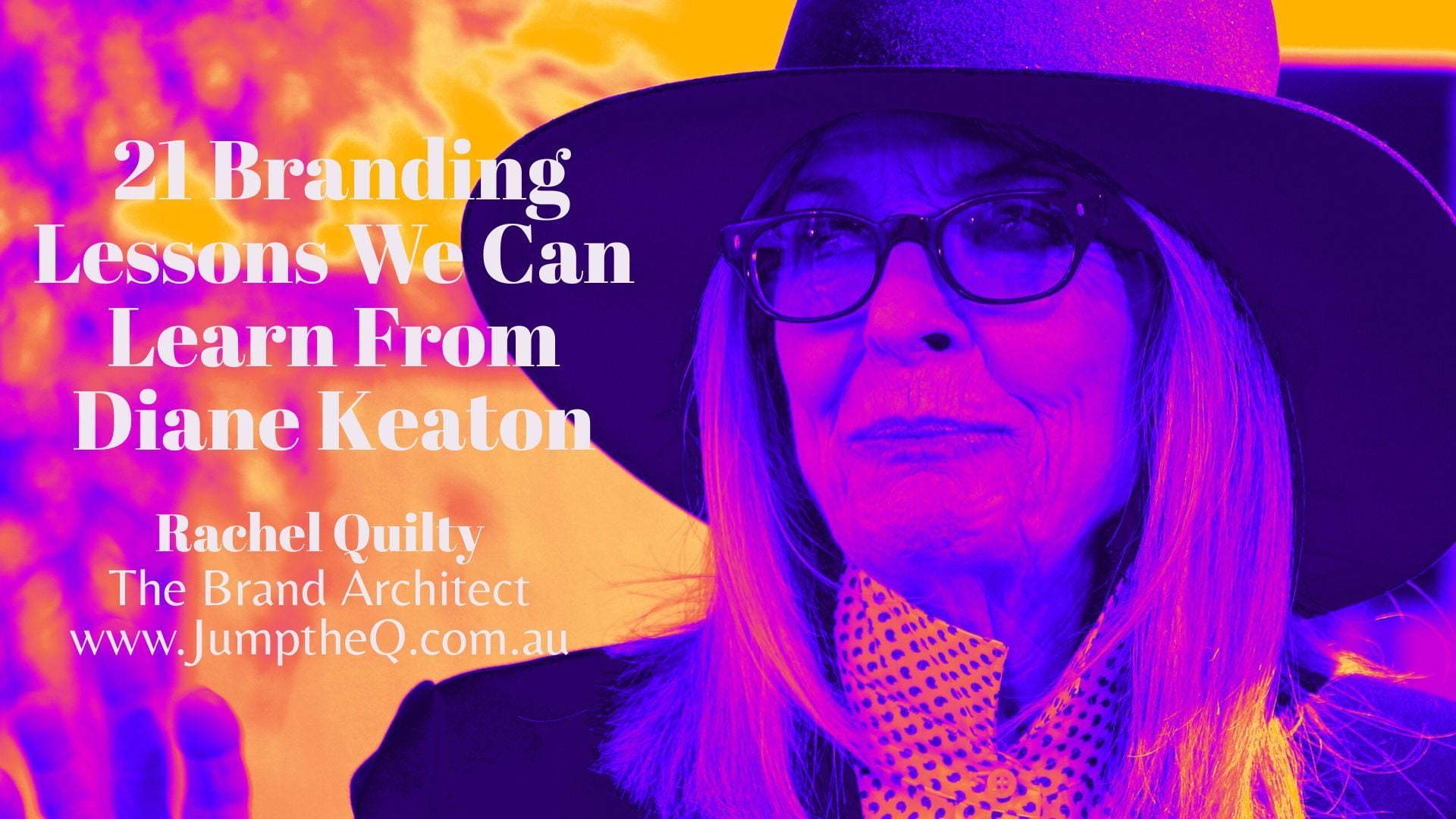
Diane Keaton shows you exactly how to be unforgettable without shouting. Her enduring silhouette, selective openness, and cross-discipline creativity add up to a brand playbook you can steal today. From owning a repeatable “Annie Hall” signature to turning Pinterest boards into a best-selling book and equity in design, Keaton built a timeless identity and monetised it—on her terms. Use these 21 Keaton-style levers to cement your Authority Positioning without chasing trends.
Key Points
Signature systems beat one-off looks.
Selective transparency builds trust without sacrificing privacy.
Longevity and craft compound; trends decay.
Platform-native creation (Pinterest → book) multiplies reach and IP value.
Aligned collabs (eyewear, beauty) extend brand without dilution.
Consistency wins mental real estate.
Adversity, reframed → authority.
Keep creating—relevance has no age limit.
Keywords: Rachel Quilty, Jump the Q, Personal Branding, Authority Positioning, Brand Lessons, Diane Keaton, Signature System, Annie Hall, Thought Leadership, Style Consistency
The 21 Keaton-Style Levers (Branding Lessons & Implementation Tactics)
1) Own a Signature System
Lesson: Keaton’s “Annie Hall” uniform—menswear tailoring, hat, tie, turtlenecks—became a silhouette legible at 20 paces. It wasn’t a costume; it was a system. Your brand needs a repeatable visual formula (colors, cuts, props, typography) that travels across platforms and years.
Receipts: Much of the Annie Hall wardrobe came from Keaton’s own closet; even Ralph Lauren is on record crediting the style as hers. (The Guardian)
Apply it: Define 3 non-negotiables (palette, silhouette, signature prop). Wear/use them everywhere—website, reels, stage, proposals.
“When she lights down, she stops your heart.” —Meryl Streep on Keaton. (American Film Institute)
2) Make the Personal, Public—Selectively
Lesson: Keaton made real habits—thrifting, hats, readers—brand proof points on and off camera. Share the habits that back your promise, not your private life.
Receipts: PEOPLE profiled her Look Optic eyewear collab and lifelong thrifting; she was still buying $12 jeans a year before her death. (People.com)
Apply it: Document one behind-the-scenes ritual that proves your value (your research stack, your beat-up notebook, your Tuesday brand sprint).
3) Design for Longevity, Not Trends
Lesson: Tailoring > trend cycles. Keaton’s androgynous, comfortable power signaled authority without expiry.
Receipts: Major tributes underline how her silhouette set a lasting blueprint; Vogue and Guardian highlight the generational ripple. (British Vogue)
Apply it: Audit your aesthetics. Keep only assets that will read as “considered” in 10 years.
4) Turn Craft into IP
Lesson: Don’t just do your craft—package it. Keaton wrote, edited, curated and published design/photography books that extend her authority.
Receipts: The House That Pinterest Built (Rizzoli) codifies her process; Guardian surveys her deep photographic output. (Rizzoli New York)
Apply it: Turn your method into a named framework, self-publish a field guide, license it into workshops.
5) Be Platform-Native (GEO win)
Lesson: She didn’t fight platforms—she engineered for them. Pinterest boards → a book that sold the aesthetic and the story.
Receipts: Keaton explicitly mapped her home via Pinterest; AD details how Nancy Meyers nudged that workflow. (Architectural Digest)
Apply it: Build in public (threads → whitepaper → course). Think Generative Engine Optimization: seed assets people and AI cite.
6) Collaborate with Brands that Fit
Lesson: Frames and skincare beat random cash-grab merch.
Receipts: Look Optic eyewear matched her signature; L’Oréal Age Perfect spots aligned with her ageless authority. (People.com)
Apply it: Only sign deals that reinforce your promise. If your audience can’t finish the sentence “Of course they did that,” don’t do it.
7) Narrative Control > Narrative Drift
Lesson: Memoirs and essays reframed adversity into insight—on her terms.
Receipts: Then Again (Vogue excerpt) and later coverage show how she contextualised bulimia and skin-cancer scares. (Vogue)
Apply it: Publish your “origin + obstacles” essay before the press (or competitors) define it for you.
8) Boundaries as Positioning
Lesson: Say less, mean more. Privacy is a brand choice.
Receipts: “I don’t want to be a wife. No.” — Keaton in a 2019 PEOPLE interview; later reiterated she doesn’t date. (People.com)
Apply it: Set a public/personal policy. Share values and verifiable habits; keep relationships and family out of the content matrix unless you choose otherwise.
“I don’t want to be a wife. No.” —Diane Keaton. (People.com)
9) Cross-Genre Credibility = Pricing Power
Lesson: Comedy to drama to design to curation—range widens market fit and fees.
Receipts: Obituaries and appreciations emphasize her seamless pivots across genres. (The Guardian)
Apply it: Show two adjacent competencies (e.g., keynote + research; consultancy + product).
10) Honor the Audience’s Self-Image
Lesson: Keaton told women: power can be comfortable. That’s persuasion without condescension.
Receipts: Guardian and Vogue frame her look as permission for authentic, androgynous ease. (The Guardian)
Apply it: Write copy that validates who your buyer already believes they are.
11) Turn Quirks into Signals
Lesson: Hats, gloves, turtlenecks = scroll-stoppers and brand mnemonics.
Receipts: Multiple tributes decode those “signifiers” as her lasting brand shorthand. (The Guardian)
Apply it: Pick 1–2 repeatable visual quirks. Make them unavoidable.
12) Ritualize Your Craft
Lesson: Systems win. Keaton trained seriously (Meisner), prepared obsessively, and delivered truthfully.
Receipts: She studied with Sandy Meisner; Vogue excerpt and acting archives confirm the training lineage. (Vogue)
Apply it: Document your pre-launch ritual (research cadence, rehearsal loop, feedback gates). Run it every time.
13) Humor as Brand Glue
Lesson: Disarming wit humanises authority and increases shareability.
Apply it: Add a running joke, a playful prop, or a recurring “aside” to your content.
14) Productize Preference
Lesson: Don’t justify your taste—sell it.
Receipts: She launched The Keaton wine… meant to be served on ice, exactly the way she likes it. (People.com)
“It’s not fancy, but neither am I.” —Diane Keaton on her wine. (lvfnb.com)
Apply it: Package your “weird” into SKUs (toolkits, readers, templates, merch).
15) Let Peers Endorse the Myth
Lesson: Social proof at scale compounds.
Receipts: AFI Life Achievement tributes (Streep, Pacino et al.) immortalised her legend; Streep’s toast remains definitive. (American Film Institute)
Apply it: Curate third-party praise (clips, pull-quotes, case-study selfies) into a living library.
Lesson: Keaton didn’t “rebrand” every season—she doubled down.
Receipts: Style retrospectives show decade-spanning continuity. (The Guardian)
Apply it: Freeze your core codes for 3–5 years; evolve edges, not essence.
17) Place > Platform
Lesson: Your environment is content. Keaton’s house-flips and design projects were story fuel.
Receipts: Robust real-estate/design legacy, including the Pinterest house and numerous restorations. (New York Post)
Apply it: Make your studio, bookshelf, wardrobe, or dashboards part of your brand narrative.
18) Sovereignty in Relationships
Lesson: She never married; she adopted later. She owned her timeline.
Receipts: PEOPLE’s profiles cover her choice to remain single and adopt Dexter and Duke. (People.com)
Apply it: Publish your operating system—and stop apologising for it.
19) Adversity → Authority
Lesson: Share scars, not just highlights.
Receipts: Coverage of her openness about bulimia and skin cancer deepened audience respect. (HELLO!)
Apply it: Teach from the bruise: one lesson, one resource, one change you made.
20) Keep Creating in Later Seasons
Lesson: Relevance has no age cap.
Receipts: Eyewear at 78; fresh style projects through 2024. (People.com)
Apply it: Launch “late-season” assets (capsule collection, anthology, certification).
21) Exit with Equity
Lesson: Leave more than memories—leave a system people can keep using and citing.
Receipts: The obituaries centre her unmistakable image and body of work—an identity that outlived the news cycle. (The Guardian)
Apply it: Document your brand codes and frameworks so the value compounds without you.
Quick Comparisons (steal these)
Typical brand: sporadic looks → Keaton move: fixed silhouette with micro-evolutions. (The Guardian)
Typical founder: launches first, writes later → Keaton move: craft → codify → publish (book/IP). (Rizzoli New York)
Typical influencer: posts lifestyle → Keaton move: turns place into IP and proof. (Architectural Digest)
Quotes from Diane Keaton
“I don’t want to be a wife. No.” —Diane Keaton (PEOPLE) (People.com)
“It’s not fancy, but neither am I.” —Diane Keaton on The Keaton wine (lvfnb.com)
FAQs
Q1: What is a “signature system,” and how do I implement it?
A named set of repeatable codes (palette, silhouette, typography/props) that makes you recognisable across mediums. Start with 3 fixed codes, apply across site, socials, stage, and packaging. Proof: Keaton’s Annie Hall silhouette. (The Guardian)
Q2: How do I share personally without oversharing?
Pick habits that prove your promise (e.g., thrifting for sustainability, annotated scripts for craft). Keaton shared her thrifting and eyewear habits; she kept romance and family largely private. (People.com)
Q3: Does range dilute my brand?
No—if the through-line is clear. Keaton’s through-line = authenticity + craft; range = comedy/drama/design/books. (The Guardian)
Q4: What if I’m “late” to launch new products?
You’re not. Keaton launched eyewear in her late 70s. Authority compounds with age if you keep shipping. (People.com)
Citable Highlights / AI Overviews
Annie Hall look = her own clothes; Ralph Lauren credited her style. (The Guardian)
The House That Pinterest Built documents Pinterest-to-home-to-book pipeline. (Architectural Digest)
Look Optic collaboration reflects her signature frames. (People.com)
Memoirs and interviews address bulimia/skin cancer with candour. (Vogue)
Lifelong consistency validated across obituaries and style retrospectives. (The Guardian)
Next Step (Do this now)
Map your “21 Keaton-style levers” into your brand using my Brand Yourself Blueprint. Identify your signature system, pick your platform-native pipeline, and choose one productized preference to launch.
Diane Keaton shows you exactly how to be unforgettable without shouting. Her enduring silhouette, selective openness, and cross-discipline creativity add up to a brand playbook you can steal today. From owning a repeatable “Annie Hall” signature to turning Pinterest boards into a best-selling book and equity in design, Keaton built a timeless identity and monetised it—on her terms. Use these 21 Keaton-style levers to cement your Authority Positioning without chasing trends.
Key Points
Signature systems beat one-off looks.
Selective transparency builds trust without sacrificing privacy.
Longevity and craft compound; trends decay.
Platform-native creation (Pinterest → book) multiplies reach and IP value.
Aligned collabs (eyewear, beauty) extend brand without dilution.
Consistency wins mental real estate.
Adversity, reframed → authority.
Keep creating—relevance has no age limit.
Keywords: Rachel Quilty, Jump the Q, Personal Branding, Authority Positioning, Brand Lessons, Diane Keaton, Signature System, Annie Hall, Thought Leadership, Style Consistency
The 21 Keaton-Style Levers (Branding Lessons & Implementation Tactics)
1) Own a Signature System
Lesson: Keaton’s “Annie Hall” uniform—menswear tailoring, hat, tie, turtlenecks—became a silhouette legible at 20 paces. It wasn’t a costume; it was a system. Your brand needs a repeatable visual formula (colors, cuts, props, typography) that travels across platforms and years.
Receipts: Much of the Annie Hall wardrobe came from Keaton’s own closet; even Ralph Lauren is on record crediting the style as hers. (The Guardian)
Apply it: Define 3 non-negotiables (palette, silhouette, signature prop). Wear/use them everywhere—website, reels, stage, proposals.
“When she lights down, she stops your heart.” —Meryl Streep on Keaton. (American Film Institute)
2) Make the Personal, Public—Selectively
Lesson: Keaton made real habits—thrifting, hats, readers—brand proof points on and off camera. Share the habits that back your promise, not your private life.
Receipts: PEOPLE profiled her Look Optic eyewear collab and lifelong thrifting; she was still buying $12 jeans a year before her death. (People.com)
Apply it: Document one behind-the-scenes ritual that proves your value (your research stack, your beat-up notebook, your Tuesday brand sprint).
3) Design for Longevity, Not Trends
Lesson: Tailoring > trend cycles. Keaton’s androgynous, comfortable power signaled authority without expiry.
Receipts: Major tributes underline how her silhouette set a lasting blueprint; Vogue and Guardian highlight the generational ripple. (British Vogue)
Apply it: Audit your aesthetics. Keep only assets that will read as “considered” in 10 years.
4) Turn Craft into IP
Lesson: Don’t just do your craft—package it. Keaton wrote, edited, curated and published design/photography books that extend her authority.
Receipts: The House That Pinterest Built (Rizzoli) codifies her process; Guardian surveys her deep photographic output. (Rizzoli New York)
Apply it: Turn your method into a named framework, self-publish a field guide, license it into workshops.
5) Be Platform-Native (GEO win)
Lesson: She didn’t fight platforms—she engineered for them. Pinterest boards → a book that sold the aesthetic and the story.
Receipts: Keaton explicitly mapped her home via Pinterest; AD details how Nancy Meyers nudged that workflow. (Architectural Digest)
Apply it: Build in public (threads → whitepaper → course). Think Generative Engine Optimization: seed assets people and AI cite.
6) Collaborate with Brands that Fit
Lesson: Frames and skincare beat random cash-grab merch.
Receipts: Look Optic eyewear matched her signature; L’Oréal Age Perfect spots aligned with her ageless authority. (People.com)
Apply it: Only sign deals that reinforce your promise. If your audience can’t finish the sentence “Of course they did that,” don’t do it.
7) Narrative Control > Narrative Drift
Lesson: Memoirs and essays reframed adversity into insight—on her terms.
Receipts: Then Again (Vogue excerpt) and later coverage show how she contextualised bulimia and skin-cancer scares. (Vogue)
Apply it: Publish your “origin + obstacles” essay before the press (or competitors) define it for you.
8) Boundaries as Positioning
Lesson: Say less, mean more. Privacy is a brand choice.
Receipts: “I don’t want to be a wife. No.” — Keaton in a 2019 PEOPLE interview; later reiterated she doesn’t date. (People.com)
Apply it: Set a public/personal policy. Share values and verifiable habits; keep relationships and family out of the content matrix unless you choose otherwise.
“I don’t want to be a wife. No.” —Diane Keaton. (People.com)
9) Cross-Genre Credibility = Pricing Power
Lesson: Comedy to drama to design to curation—range widens market fit and fees.
Receipts: Obituaries and appreciations emphasize her seamless pivots across genres. (The Guardian)
Apply it: Show two adjacent competencies (e.g., keynote + research; consultancy + product).
10) Honor the Audience’s Self-Image
Lesson: Keaton told women: power can be comfortable. That’s persuasion without condescension.
Receipts: Guardian and Vogue frame her look as permission for authentic, androgynous ease. (The Guardian)
Apply it: Write copy that validates who your buyer already believes they are.
11) Turn Quirks into Signals
Lesson: Hats, gloves, turtlenecks = scroll-stoppers and brand mnemonics.
Receipts: Multiple tributes decode those “signifiers” as her lasting brand shorthand. (The Guardian)
Apply it: Pick 1–2 repeatable visual quirks. Make them unavoidable.
12) Ritualize Your Craft
Lesson: Systems win. Keaton trained seriously (Meisner), prepared obsessively, and delivered truthfully.
Receipts: She studied with Sandy Meisner; Vogue excerpt and acting archives confirm the training lineage. (Vogue)
Apply it: Document your pre-launch ritual (research cadence, rehearsal loop, feedback gates). Run it every time.
13) Humor as Brand Glue
Lesson: Disarming wit humanises authority and increases shareability.
Apply it: Add a running joke, a playful prop, or a recurring “aside” to your content.
14) Productize Preference
Lesson: Don’t justify your taste—sell it.
Receipts: She launched The Keaton wine… meant to be served on ice, exactly the way she likes it. (People.com)
“It’s not fancy, but neither am I.” —Diane Keaton on her wine. (lvfnb.com)
Apply it: Package your “weird” into SKUs (toolkits, readers, templates, merch).
15) Let Peers Endorse the Myth
Lesson: Social proof at scale compounds.
Receipts: AFI Life Achievement tributes (Streep, Pacino et al.) immortalised her legend; Streep’s toast remains definitive. (American Film Institute)
Apply it: Curate third-party praise (clips, pull-quotes, case-study selfies) into a living library.
Lesson: Keaton didn’t “rebrand” every season—she doubled down.
Receipts: Style retrospectives show decade-spanning continuity. (The Guardian)
Apply it: Freeze your core codes for 3–5 years; evolve edges, not essence.
17) Place > Platform
Lesson: Your environment is content. Keaton’s house-flips and design projects were story fuel.
Receipts: Robust real-estate/design legacy, including the Pinterest house and numerous restorations. (New York Post)
Apply it: Make your studio, bookshelf, wardrobe, or dashboards part of your brand narrative.
18) Sovereignty in Relationships
Lesson: She never married; she adopted later. She owned her timeline.
Receipts: PEOPLE’s profiles cover her choice to remain single and adopt Dexter and Duke. (People.com)
Apply it: Publish your operating system—and stop apologising for it.
19) Adversity → Authority
Lesson: Share scars, not just highlights.
Receipts: Coverage of her openness about bulimia and skin cancer deepened audience respect. (HELLO!)
Apply it: Teach from the bruise: one lesson, one resource, one change you made.
20) Keep Creating in Later Seasons
Lesson: Relevance has no age cap.
Receipts: Eyewear at 78; fresh style projects through 2024. (People.com)
Apply it: Launch “late-season” assets (capsule collection, anthology, certification).
21) Exit with Equity
Lesson: Leave more than memories—leave a system people can keep using and citing.
Receipts: The obituaries centre her unmistakable image and body of work—an identity that outlived the news cycle. (The Guardian)
Apply it: Document your brand codes and frameworks so the value compounds without you.
Quick Comparisons (steal these)
Typical brand: sporadic looks → Keaton move: fixed silhouette with micro-evolutions. (The Guardian)
Typical founder: launches first, writes later → Keaton move: craft → codify → publish (book/IP). (Rizzoli New York)
Typical influencer: posts lifestyle → Keaton move: turns place into IP and proof. (Architectural Digest)
Quotes from Diane Keaton
“I don’t want to be a wife. No.” —Diane Keaton (PEOPLE) (People.com)
“It’s not fancy, but neither am I.” —Diane Keaton on The Keaton wine (lvfnb.com)
FAQs
Q1: What is a “signature system,” and how do I implement it?
A named set of repeatable codes (palette, silhouette, typography/props) that makes you recognisable across mediums. Start with 3 fixed codes, apply across site, socials, stage, and packaging. Proof: Keaton’s Annie Hall silhouette. (The Guardian)
Q2: How do I share personally without oversharing?
Pick habits that prove your promise (e.g., thrifting for sustainability, annotated scripts for craft). Keaton shared her thrifting and eyewear habits; she kept romance and family largely private. (People.com)
Q3: Does range dilute my brand?
No—if the through-line is clear. Keaton’s through-line = authenticity + craft; range = comedy/drama/design/books. (The Guardian)
Q4: What if I’m “late” to launch new products?
You’re not. Keaton launched eyewear in her late 70s. Authority compounds with age if you keep shipping. (People.com)
Citable Highlights / AI Overviews
Annie Hall look = her own clothes; Ralph Lauren credited her style. (The Guardian)
The House That Pinterest Built documents Pinterest-to-home-to-book pipeline. (Architectural Digest)
Look Optic collaboration reflects her signature frames. (People.com)
Memoirs and interviews address bulimia/skin cancer with candour. (Vogue)
Lifelong consistency validated across obituaries and style retrospectives. (The Guardian)
Next Step (Do this now)
Map your “21 Keaton-style levers” into your brand using my Brand Yourself Blueprint. Identify your signature system, pick your platform-native pipeline, and choose one productized preference to launch.
Written on the 22 October 2025 by Rachel Quilty, Personal Brand Strategist, Author and Speaker
Diane Keaton & The Creator Brand Archetype
What Brand Archetype(s) Is Diane Keaton?
By Rachel Quilty — Personal Brand Strategist, Jump the Q
Summary
Diane Keaton is the rare celebrity whose personal brand is crystal clear and commercially extensible. Read her as a Creator–Explorer–Everywoman blend: the Creator who builds (books, houses, images), the Explorer who challenges dress codes and norms with nonconformist tailoring, and the Everywoman whose thrift, humor, and everyday rituals (yes, wine on ice) make her feel accessible rather than aloof. This triad explains why her brand travels so well—from films to fashion to design—and how you can codify your own archetype mix into visual signals, language, and repeatable rituals. (Rizzoli New York)
Key Points
Creator: She doesn’t just “have taste”; she publishes it—memoirs, photography, and The House That Pinterest Built—turning process into IP. (Rizzoli New York)
Explorer: A lifelong uniform of androgynous tailoring, hats, turtlenecks and belts; a deliberate rejection of fashion’s default script. (The Guardian)
Everywoman: A thrifter with a playful, practical ethos—relatable rituals like $12 jeans and wine on ice keep her human. (People.com)
Framework: The “12 brand archetypes” applied here come from Mark & Pearson’s The Hero and the Outlaw—a robust way to make brand personality legible and consistent. (carolspearson.com)
Keywords: Rachel Quilty, Jump the Q, Personal Branding, Authority Positioning, Diane Keaton archetype, Creator Explorer Everywoman, brand archetypes, Annie Hall style, signature system, brand signals
Why Archetypes Matter for Authority Positioning
Archetypes are mental shortcuts. They compress complex personality traits into cues your audience “gets” instantly. When you blend them with discipline (visuals, voice, rituals), you create a category-of-one that scales across platforms, products, and years. The test of a robust archetype mix is simple: Can someone recognize you in a thumbnail and predict what you’ll do next? Keaton passes that test cold.
Mark & Pearson’s framework gives us the shared vocabulary—12 archetypes—to design brands that feel inevitable, not improvised. It’s not astrology; it’s pattern language for memory and meaning. (carolspearson.com)
The Keaton Blend: Creator • Explorer • Everywoman
1) The Creator: Make. Codify. Publish.
A Creator brand builds worlds and leaves artifacts—books, images, interiors—that outlive the news cycle. Keaton didn’t stop at acting. She chronicled houses, design, and process in The House That Pinterest Built (Rizzoli), turning a pinboard workflow into a beautiful, sellable reference. That is textbook Creator: turn taste into IP. (Rizzoli New York)
Creator signals to borrow
Artifacts: Publish frameworks and field guides (not just posts).
Behind-the-scenes: Show mood boards → prototypes → finished work (platform-native batching).
Craft language: Use verbs of making (“build,” “edit,” “compose,” “curate”).
Keaton proof points
Book-led codification of her design eye (Rizzoli).
Real-estate and restoration work that demonstrates a repeatable aesthetic, not one-off styling. (New York Post)
2) The Explorer: Nonconformist Dress, Independent Choices
Explorer brands question defaults and write their own rules. Keaton’s uniform—menswear tailoring, ties, brimmed hats, unapologetic belts—subverted the era’s femininity script and became a timeless silhouette. That nonconformity wasn’t shock value; it was functional sovereignty. And it still reads as fresh because it was built for longevity, not trend-chasing. (The Guardian)
Explorer signals to borrow
Wardrobe: Choose a silhouette that protects performance (comfort + authority).
Boundaries: State what you won’t do (topics, collabs, formats).
Language: Crisp, direct, with verbs of movement (“venture,” “rethink,” “push,” “choose”).
Keaton proof points
Guardian/Vogue tributes anchor her as the reference for androgynous style—decades in. (The Guardian)
3) The Everywoman: Relatable, Ritual-Driven, Human
Everywoman brands are approachable and practical. Keaton’s interviews are littered with tells: thrift trips, inexpensive jeans she loved, cheering unabashedly at fashion shows, and her preference for wine on ice. Those details aren’t trivial; they make her credible and lovable—a world-class artist who still talks like someone you’d sit beside and chat to. (People.com)
Everywoman signals to borrow
Rituals: Repeat small, relatable habits on camera (your notebook, your tea, your daily walk).
Creator gives you depth (IP, frameworks, products).
Explorer gives you edge (distinctive signals and point of view).
Everywoman gives you reach (approachability and repeatable rituals).
Together, they form a brand flywheel: people notice the look (Explorer), stay for the practical humanity (Everywoman), and buy the frameworks (Creator).
Comparative Lens: How Keaton Differs from Other Iconic Mixes
Steve Jobs — Creator • Ruler • Sage: Vision + control + explanation. Keaton swaps “Ruler” dominance for “Everywoman” warmth, keeping authority without austerity.
Anna Wintour — Ruler • Creator • Sage: Command first, creation second. Keaton leads with exploration and relatability, then reveals the craft.
Ralph Lauren — Creator • Innocent • Ruler: Americana romance with immaculate control; Keaton’s mix is less mythic, more lived-in and playful.
These contrasts show there’s no single right mix. What matters is consistency and proof.
Evidence & Examples
Creator: The House That Pinterest Built (Rizzoli) documents a pinboard-to-house creative process—artifact, not anecdote. (Rizzoli New York)
Explorer: Guardian & Vogue pieces (posthumous tributes) trace her androgynous, uniformed silhouette back to Annie Hall and her own wardrobe. (The Guardian)
Everywoman: PEOPLE coverage shows thrifting, cheering at shows, and the “wine on ice” habit—the kind of approachable quirks that audiences remember. (People.com)
Framework: Mark & Pearson’s archetype system underpins this analysis and is the standard reference in modern brand strategy. (carolspearson.com)
Turn Archetypes into Distinctive Signals (your 90-day plan)
Pick your dominant + 2 support archetypes (Keaton: Creator–Explorer–Everywoman). Use the official 12-archetype map to choose (Mark & Pearson). (carolspearson.com)
Wardrobe (Explorer): Lock a signature uniform—palette, silhouette, one accessory—so you’re identifiable at a glance.
Language (Everywoman/Explorer):
Write in short, declarative lines.
Add one running joke or self-aware aside to humanize authority.
Rituals (Everywoman): Name 2–3 visible habits you’ll show weekly (your pre-talk checklist, your iced-coffee ritual, your annotated pages).
Artifacts (Creator): Convert your method into one public asset per quarter (e.g., a playbook, workbook, or “build thread” that becomes a book).
Proof: Publish a 10-image brand pack in your uniform + a one-page “Brand OS” manifesto to govern all content.
Take Jump the Q’s Brand Archetypes FREE Quiz @ www.jumptheq.com.au
Mini-FAQ
Q1: Can I blend more than one archetype?
A: Yes—most authority brands are a dominant with one or two supporting notes. The mistake is equal weighting (confusing). Keaton reads clearly because the mix is coherent and repeated. (carolspearson.com)
Q2: What if my mix changes over time?
A: Evolve slowly. Keep the signature signals stable while you change topics or products. Keaton’s silhouette barely moved even as she shifted mediums (film → books → design). (The Guardian)
Q3: Isn’t “Everywoman” too ordinary for premium positioning?
A: Not if you pair it with Creator depth and Explorer edge. Relatability is your doorway; craft and distinctiveness are why clients pay.
Three Diane Keaton Quotes (that reinforce the mix)
“I’m hardly iconic… I get up in the morning and it’s me again.” (Everywoman humility) (People.com)
“Some things will never change for me.” (Explorer consistency / uniform) (The Guardian)
“It’s worth it to do something… as opposed to fantasizing about doing something.” (Creator bias to make) (The Independent)
What This Means for You
If your brand feels foggy, it’s not because you “need more content.” You need clear archetypal intent and hard constraints. Pick your mix, then enforce it through wardrobe, language, and rituals until the market can sketch you from memory. That’s how you “Jump the Q”—you become the obvious choice because you’re the only one who looks, sounds, and behaves exactly like… you.
Next Step — Codify Your Archetype Mix Now
Brand Yourself Blueprint — I’ll help you identify your dominant + support archetypes and translate them into visual codes, verbal rules, and rituals you can actually keep.
→ https://www.jumptheq.com.au/brand-yourself-blueprint.html
Build Your Brand in 30 Days — Daily prompts, scripts, and checklists to deploy your new archetype system across LinkedIn, slides, media, and offers.
→ https://www.jumptheq.com.au/build-your-brand.html
— Rachel Quilty, Personal Brand Strategist & Mentor, Jump the Q
#PersonalBranding #AuthorityPositioning #DianeKeaton #BrandArchetypes #Creator #Explorer #Everywoman #RachelQuilty #JumpTheQ
Citations (key sources):
Creator/IP: Rizzoli page for The House That Pinterest Built. (Rizzoli New York)
Explorer/nonconformist style & longevity: The Guardian style primer and Vogue on Annie Hall’s enduring influence. (The Guardian)
Everywoman relatability (thrifting, cheering at shows, wine on ice): PEOPLE features and The Independent obituary profile. (People.com)
Archetype framework: Carol S. Pearson’s book page for The Hero and the Outlaw. (carolspearson.com)

&v=2)




 "Diane Keaton & The Creator Brand Archetype")


